







In light of the controversy surrounding the 2025 Unified Tertiary Matriculation Examination (UTME), it’s worth recalling that this isn’t the first time the Joint Admissions and Matriculation Board (JAMB) has been forced to invalidate a large number of exam results.
JAMB came under fire this year after it was revealed that over 78% of candidates who sat for the 2025 UTME scored below 200 out of a possible 400. The mass failure led to nationwide protests from students and parents, raising questions about the credibility of the exams.


Following an internal review, JAMB admitted that a technical error — traced to one of its service providers — distorted the results of nearly 380,000 candidates across 157 centres, particularly in Lagos and the South-East.
In an emotional address aired on May 14, JAMB Registrar, Prof. Ishaq Oloyede, publicly apologised to the affected candidates and Nigerians, confirming that a resit would be held between May 16 and 19. Candidates were instructed to await further communication via SMS, email, and phone calls.
Prof. Oloyede also explained that the error stemmed from a software patch intended to implement shuffled answer options — a new anti-malpractice measure.

Despite extensive testing, the update was improperly applied in some centres, leading to the error.
READ ALSO: UTME 2025: African Universities Commend JAMB For Transparency On Results Glitch
Yet, a look back in time shows that this is not an isolated case in JAMB’s history.
Flashback to 1997: A Massive UME Purge
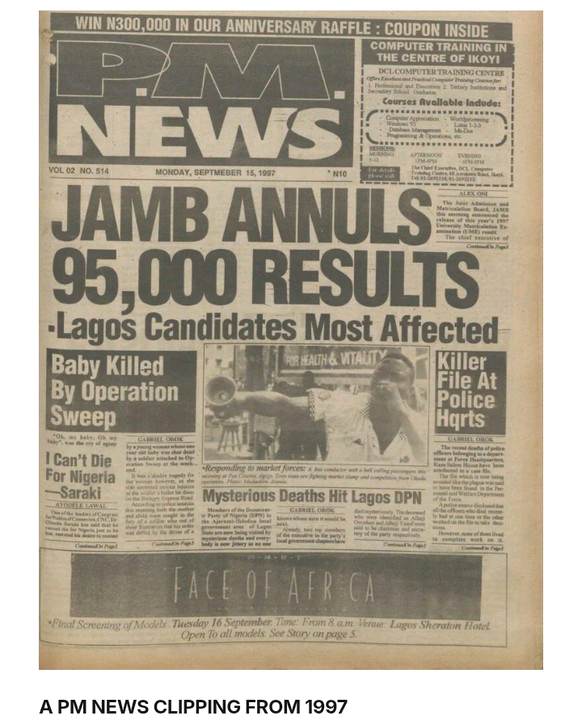
On September 15, 1997, under the leadership of then-Registrar Bello Salim, JAMB announced the cancellation of 95,000 University Matriculation Examination (UME) results out of a total 471,000. The reason? What was described as “massive widespread cheating.”
According to reports from PM News archives, Lagos was the most affected area, with cases ranging from impersonation to the swapping of exam scripts. The scandal led to widespread outrage and even calls for the scrapping of JAMB during its 20th anniversary celebrations the following year.
Then and Now: Malpractice Still Evolving
While cheating in 1997 was largely physical, JAMB now contends with more sophisticated forms of malpractice.
In the 2025 bulletin published on March 11, the board detailed how biometric fraud, duplicate National Identification Numbers (NINs), messaging app syndicates, and even miniature hidden cameras have become part of exam fraud tactics.
Though the number of withheld results for general infractions decreased to 96 in 2025 (from 123 in 2024), JAMB is still grappling with tech-enabled malpractice. In a particularly alarming trend, 244 results were withheld due to WhatsApp-related exam fraud.
 We do everything possible to supply quality news and information to all our valuable readers day in, day out and we are committed to keep doing this.
Your kind donation will help our continuous research efforts.
-Advertisement-

-Want to get the news as it breaks?-





