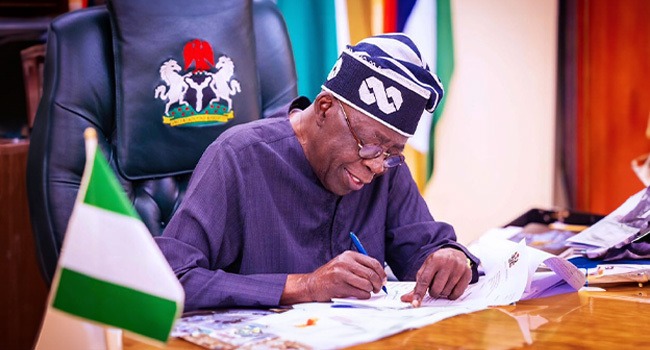

President Bola Tinubu has approved a sharp increase in the budget of the Code of Conduct Bureau (CCB), raising its funding from about ₦3 billion to nearly ₦20 billion as part of efforts to strengthen Nigeria’s anti-corruption framework.
The Chairman of the CCB, Abubakar Bello, disclosed this on Sunday in Abuja during an interview with the News Agency of Nigeria. He said the approval would allow the bureau to overhaul its outdated asset declaration process and improve enforcement.
According to Bello, the bureau has for years relied on a largely manual system, with public officers filling paper forms that were costly to print, difficult to store and almost impossible to verify effectively.


“When I assumed office, I discovered that asset declaration was still being done manually,” he said. “Forms were scarce, expensive, and we could not meet the demands of millions of public servants across the country.”
He explained that the 2025 budget provided only about ₦70 million for printing asset declaration forms—an amount that could produce no more than 60,000 forms for over 4.5 million public servants nationwide.
To cope with the shortage, the bureau temporarily allowed officers to download forms from its website, a model adapted from Kenya. However, Bello said this only addressed availability and not the deeper problems of verification and enforcement.

With the new funding, the CCB is developing a fully digital asset declaration platform expected to go live in the first quarter of 2026. The system will allow public servants to declare assets online from anywhere in the world.
Bello described the platform as a “game changer,” noting that it will be linked directly to key databases, including the Corporate Affairs Commission, Federal Inland Revenue Service, Bank Verification Number system and land registries.
READ ALSO: 2027: Tinubu’s re-election should be top priority for APC – Aiyedatiwa
He added that artificial intelligence would be used to analyse declarations, compare changes in net worth over time and flag unexplained wealth or possible violations for further review.
As part of the reforms, the bureau has begun inviting ministers, permanent secretaries and other senior officials for asset verification. Bello stressed that verification should not be confused with investigation.
He revealed that the Attorney-General of the Federation and Minister of Justice, Lateef Fagbemi, had personally appeared to verify his assets, describing the move as leadership by example.
Bello said the verification exercise had already led to interim forfeiture orders in cases where officials failed to declare assets or could not explain their sources, including properties within and outside Nigeria. Some recovered funds, he added, have been transferred to the Central Bank of Nigeria.
He warned public servants that failure to comply with asset declaration rules or refusal to honour verification invitations could lead to investigation and prosecution before the Code of Conduct Tribunal.
“Our guiding principle is simple,” Bello said. “Declare or forfeit.”
 We do everything possible to supply quality news and information to all our valuable readers day in, day out and we are committed to keep doing this.
Your kind donation will help our continuous research efforts.
-Advertisement-

-Want to get the news as it breaks?-