


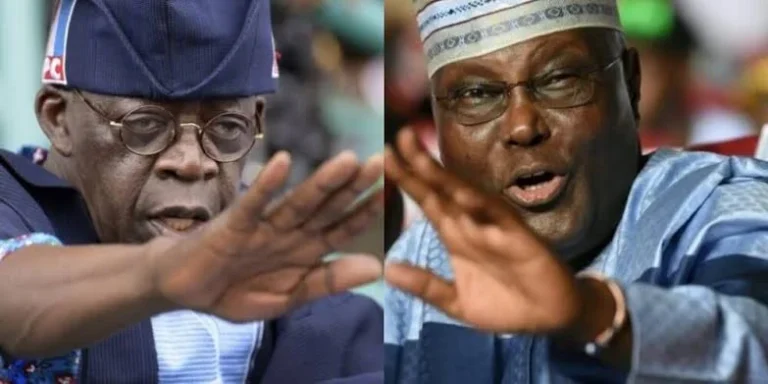
Former Vice-President Atiku Abubakar has challenged President Bola Tinubu to adopt his proposal for reducing petrol prices, saying the president could rename the plan and take the credit if it would make life easier for Nigerians.
Atiku said the effects of petrol subsidy removal had extended beyond filling stations to transport fares, market prices, businesses and household budgets.
In an address on fuel prices, palliatives and the cost of living, he urged Tinubu to use the remaining eight months of his administration to reduce the burden on households and businesses rather than rely mainly on temporary relief.

“When government makes energy expensive, it makes life expensive. This is no longer an argument between economists. It is the daily reality of millions of Nigerians,” he said.
Atiku recalled that Tinubu had previously dismissed his call for government intervention to reduce petrol prices as showing “serious ignorance” of governance and the economy.
He argued that concerns raised by workers, petroleum marketers, manufacturers and ordinary Nigerians should prompt the government to reconsider its approach.

“When workers, producers, marketers and ordinary families are all raising the alarm, government must listen,” he said.
The former vice-president said leadership required the humility to acknowledge the consequences of policies and the courage to change direction.
He also questioned the emphasis on gross domestic product growth, increased government revenue and larger allocations, saying Nigerians were more concerned about what their incomes could buy.
“Government celebrates GDP growth, higher revenues and bigger allocations. But Nigerians judge the economy by what their money can buy,” he said.
According to Atiku, manufacturers are facing rising production costs while consumers are losing the purchasing power needed to buy goods.
“The goods are there. The need is there. What is missing is the purchasing power,” he said.
He urged Tinubu not to allow political ownership of the proposal to prevent its adoption.
“Bola Tinubu should not be ashamed to do what is necessary to lower the price of petrol simply because Atiku Abubakar proposed a government intervention,” he said.
“He should just take the idea. Rename it if he wishes, and even take the credit. What matters to me is that Nigerians pay less.”
Atiku also criticised reliance on palliatives as the principal response to the cost-of-living crisis, arguing that temporary assistance could not replace policies addressing the underlying causes of high production and living costs.
“Do not make life unbearable and then distribute bags of rice as evidence of compassion. Palliatives manage pain. Good policy addresses the source of the pain,” he said.
Atiku cautions against electricity subsidy approach
The former vice-president warned the government against repeating the petrol subsidy experience as electricity subsidies are expected to be phased out from 2027.
He said households and businesses were already struggling with electricity costs, while manufacturers were spending heavily on power, diesel and alternative energy sources to keep their operations running.
“The lesson of petrol must not be repeated with electricity. Do not remove first and think later. Do not impose the pain first and search for palliatives afterwards,” he said.
Atiku offered to provide his policy framework to the administration, saying Nigerians should not have to wait for another government to benefit from a proposal intended to ease hardship.
“Nigerians do not have to wait for another administration before they benefit from an idea that can help them today,” he said.
“If you need the framework, I will provide it. Implement it under your government. Give it whatever name you choose. Take the credit.”
Proposes support for locally refined petroleum
Atiku also outlined his proposed petrol pricing policy if elected president in 2027, promising a transparent production subsidy for petroleum products refined in Nigeria and sold to Nigerian consumers.
He said imported petroleum products would not qualify for the proposed support.
According to him, the scheme would have a fixed spending limit, require National Assembly approval and be subject to independent audits.
Atiku compared the proposal with government support for a Nigerian rice miller. He argued that reducing milling costs could lower rice prices, increase demand for locally produced paddy and create more business and jobs in farming, processing, packaging and transportation.
He said the same principle should apply to petroleum, with government support tied to domestic production and lower prices for consumers.
Atiku maintained that the ultimate test of economic reform was its impact on households rather than the size of government revenue or official growth figures.
“I am prepared to compete with you politically. But I will never compete with the welfare of the Nigerian people,” he said.
“The presidency may be contested. The wellbeing of Nigerians should never be.”
He said his proposed economic programme would focus on expanding production, creating jobs and ensuring that economic growth translated into greater purchasing power.
“Ultimately, Nigerians do not live on statistics. They live on what their hard-earned money can buy,” he said.
 We do everything possible to supply quality news and information to all our valuable readers day in, day out and we are committed to keep doing this.
Your kind donation will help our continuous research efforts.
-Advertisement-
-Want to get the news as it breaks?-