



Nigeria’s drive to cut transportation costs through Compressed Natural Gas is producing different outcomes across the states, with some governments already offering subsidised or free alternative-fuel transport while commercial operators elsewhere struggle with inadequate infrastructure.
The Federal Government has set October 1 as a target for measurable reductions in transport costs and has urged states to ensure that savings from cheaper energy reach commuters.
The push followed President Bola Tinubu’s August 27 meeting with the 36 state governors, after which an implementation committee for the National Affordable CNG Transit Programme was established under the Nigeria Governors’ Forum.

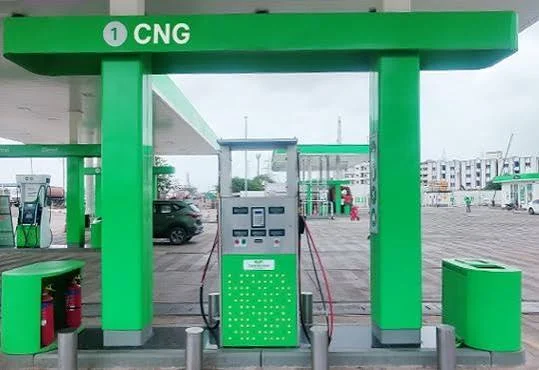
The Presidency said more than 120,000 vehicles had so far been converted, supported by over 400 certified conversion centres and more than 90 CNG refuelling stations.
But transport operators in several states say the available infrastructure is still inadequate.
Lagos offers a clear example of the challenge.

At the NIPCO CNG station in Ibafo, along the Lagos-Ibadan Expressway, commercial buses, cars and trucks have been seen waiting for hours to refuel.
A driver identified as Saheed said he had been at the station since 7:30 pm.
“We have been here since 7:30 pm. My bus is just getting close to the pump. The reason for this queue is because we have a few CNG stations along this axis,” he said.
Another commercial driver, Musa Kazeem, said the cost of conversion was beyond the reach of many operators.
“I planned to convert my vehicle last month, but they told me to look for N800,000 or N1m, depending on the size of the cylinders I want,” he said.
Kazeem said the long queues at CNG stations added another layer of uncertainty for motorists considering conversion.
The National President of NARTO, Yusuf Othman, said the queues were affecting operators’ productivity.
“The queues in CNG stations are really costing us time, because time is money,” he said.
According to him, the shortage of stations was responsible for much of the problem, but he expressed confidence that new facilities being developed by the government would improve the situation.
“There are a lot of CNG stations coming up. The government is intervening through the Midstream and Downstream Gas Infrastructure Fund,” Othman said.
He described CNG as cheaper than petrol and diesel and said increased adoption would become easier as more infrastructure became available.
States Take Different Paths
While some states are relying on CNG, others are using government-owned buses, electric vehicles or fare subsidies to reduce the burden on commuters.
Plateau State said its government-operated buses charge N200 for journeys of between 18km and 20km within Jos.
Transport Commissioner Davou Jatau described the scheme as a social intervention designed to provide affordable mobility.
He said journeys that could cost between N1,000 and N1,400 in taxis were available for N200 on government buses.
However, transport operators in the state said CNG had yet to become practical because of the absence of a functional refuelling station.
The Chairman of NTA Park, Jos, Ibrahim Maikudi, said some CNG buses supplied to Plateau were parked because operators had nowhere to refuel them.
Kaduna State has gone further with its alternative-fuel transport programme.
The state government has operated free CNG bus services since July 2025 following the deployment of 100 buses.
According to the Commissioner for Information and Culture, Ahmad Mayaki, the buses serve eight routes and about 200 bus stops.
He said the government had directed that the free service continue indefinitely.
Gombe State, however, faces infrastructure challenges.
A transport operator said CNG was useful for urban journeys but remained difficult for long-distance transportation because of the limited number of refuelling facilities.
He said a vehicle travelling to Abuja could spend six to eight hours waiting to refuel.
The operator said plans to establish about 30 CNG substations across the state could improve the situation.
The Managing Director of Gombe State Transport Service, Dr Sani Sabo, said the programme could reduce transport costs but would require additional infrastructure before it could cover all necessary routes.
Conversion Cost Remains A Concern
The cost of converting vehicles is another recurring issue.
In Jigawa, transport operators said the government’s fare-reduction target would be difficult to achieve without more CNG stations and conversion centres.
Muhd Mudi, an official of the National Association of Transport Owners, said operators were yet to see sufficient infrastructure.
In Zamfara, commercial driver Aminu Suleiman said residents had heard about CNG but had not seen a station in the state.
The state government said it planned to establish CNG facilities in Gusau and other locations.
Kwara State also recorded limited adoption.
The state RTEAN chairman, Abdulrasheed Onikijipa, said only about 100 commercial vehicles belonging to union members had been converted.
He attributed the low uptake partly to concerns among vehicle owners about possible damage and the cost of conversion.
Onikijipa also said transport unions had not been adequately consulted on the programme.
Borno operators cited safety concerns and the price of gas as factors discouraging adoption.
The state, however, has an alternative in Maiduguri, where hundreds of government-owned electric vehicles operate at fares of between N50 and N100.
More Buses, More Conversion Centres
Several states are preparing new interventions.
Benue said it was conducting an awareness campaign ahead of vehicle conversion, while its Commissioner for Transport and Energy, Dr Joseph Ter, said he had converted his official vehicle to CNG as a demonstration of support.
Nasarawa plans to establish one bi-fuel conversion centre in each of its three senatorial districts after training 50 auto technicians.
Edo State plans to launch more than 50 52-seater CNG buses in October.
The state Commissioner for Information and Strategy, Kassim Afegbua, said the buses would be distributed across the three senatorial districts based on commuter demand.
Kano State said it was collaborating with the Federal Government on CNG-powered mass transit and had also procured 500 electric tricycles.
Bayelsa transport operators said they were prepared to adopt CNG but wanted government intervention on conversion costs and station availability.
Ogun State said it was engaging relevant stakeholders on CNG adoption and exploring electric transport.
In Rivers, the government plans to return palliative buses to the roads in October, including vehicles expected to provide free services to commuters.
FG Looks To Infrastructure
The Federal Government has continued to invest in CNG infrastructure through the Midstream and Downstream Gas Infrastructure Fund.
Four projects supported by the fund were commissioned in Lagos, Abuja and Owerri in May.
The government has also introduced financing arrangements intended to reduce the immediate financial burden of converting vehicles to CNG.
The Presidency has highlighted fare reductions recorded in states where alternative-energy transport has been deployed.
It said Borno’s CNG and electric transport services charge N50 to N100 on routes where commercial operators charge N300 to N600.
It also cited an initial reduction in the Lagos-Ibadan fare from about N8,000 to N3,200 through CNG buses in Oyo, while Adamawa recorded reductions of up to 50 per cent and Enugu reduced the Enugu-Nsukka fare from N2,500 to N1,500.
However, the experiences across the states indicate that the relationship between cheaper fuel and cheaper fares depends on several other factors.
Conversion costs, access to refuelling stations, waiting time, maintenance, spare parts, financing and other operating expenses all affect the final cost borne by passengers.
 We do everything possible to supply quality news and information to all our valuable readers day in, day out and we are committed to keep doing this.
Your kind donation will help our continuous research efforts.
-Advertisement-
-Want to get the news as it breaks?-