



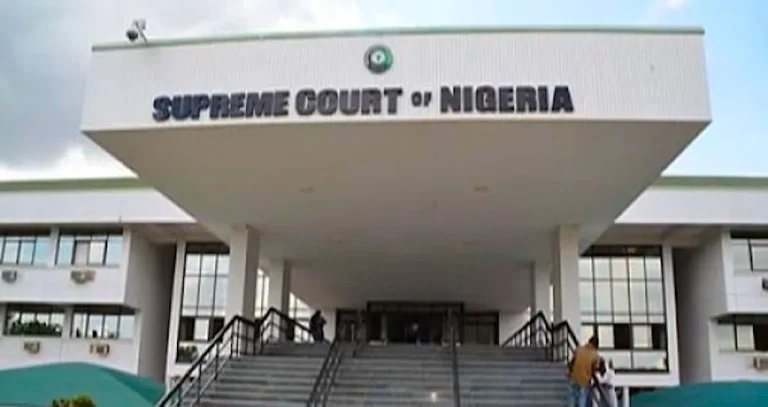

The Supreme Court’s restoration of key provisions of the Electoral Act 2026 has opened a new phase of legal questions over political party primaries and candidate nominations ahead of the 2027 general elections.
The judgment in appeal No. SC/CR/495/2026 restored Sections 77(5), 77(6), 77(7) and 84(2), provisions dealing with party membership registers and the nomination of candidates.


The case originated from a challenge by the Zenith Labour Party and subsequently went through the Federal High Court and Court of Appeal before reaching the Supreme Court. The apex court had heard the appeal on September 16 and reserved judgment at the time.
The Court of Appeal had earlier voided the disputed provisions, but the Supreme Court subsequently reversed that position and restored the provisions upheld by the Federal High Court.
The development has raised questions about the status of candidates who have already secured party tickets, especially where their emergence followed defections, substitutions or other changes in party affiliation.

Several legal practitioners, however, have cautioned against assuming that the Supreme Court ruling automatically disqualifies affected candidates.
Jawondo said completed nominations could not simply be cancelled on the strength of the judgment.
He explained that a person seeking to challenge a nomination would have to meet the relevant legal requirements, including having the necessary standing and filing within the prescribed period.
Ayorinde similarly maintained that the ruling did not create a new automatic disqualification mechanism for candidates.
He said the constitutional qualifications for elective office remained central to determining eligibility and urged INEC to ensure that implementation of the judgment did not disenfranchise parties or candidates.
Azeez offered a more case-specific interpretation, saying the judgment itself did not determine whether individual politicians complied with the membership-register requirements or whether their primaries were conducted in accordance with the law.
He said such issues could still become subjects of litigation depending on the facts surrounding individual candidates.
One case already requiring a fresh party primary is in Gombe State, where the PDP has scheduled September 29 to conduct another governorship primary.
The decision followed a September 24 judgment of the Federal High Court in Gombe, which nullified the party’s May 26 primary and ordered a fresh exercise.
The earlier primary produced Pantami, who had joined the PDP after leaving the APC. His emergence through voice affirmation was challenged by aspirant Usman Garry.
The PDP has subsequently directed eligible delegates to participate in the fresh exercise.
Attention has also been drawn to other candidates whose nomination processes could face questions, although the Supreme Court did not specifically disqualify any of them in the judgment.
Among the cases cited in the report are those involving former Inspector-General of Police Mohammed Adamu, who emerged as the Social Democratic Party governorship candidate in Nasarawa State through a substitution primary, and former House of Representatives Minority Leader Kingsley Chinda, who emerged as the APC governorship candidate in Rivers State.
Senator Saliu Mustapha, who moved from the APC to the PDP before securing the PDP senatorial ticket for Kwara Central, was also cited in relation to the wider debate.
However, the inclusion of such cases in the ongoing debate does not amount to a judicial finding that their nominations are invalid.
The legal uncertainty centres largely on how the restored provisions will apply to individual circumstances, including party membership records, timing of primaries, defections and substitutions.
The Independent National Electoral Commission is expected to play a central role in applying the provisions as political parties prepare for the 2027 elections.
The commission had yet to issue a detailed public response on the practical implications of the judgment at the time of the report.
The Supreme Court’s ruling therefore leaves political parties, aspirants and election administrators with the task of interpreting and applying the restored provisions while any candidate-specific disputes may proceed through the appropriate legal channels.
 We do everything possible to supply quality news and information to all our valuable readers day in, day out and we are committed to keep doing this.
Your kind donation will help our continuous research efforts.
-Advertisement-

-Want to get the news as it breaks?-