

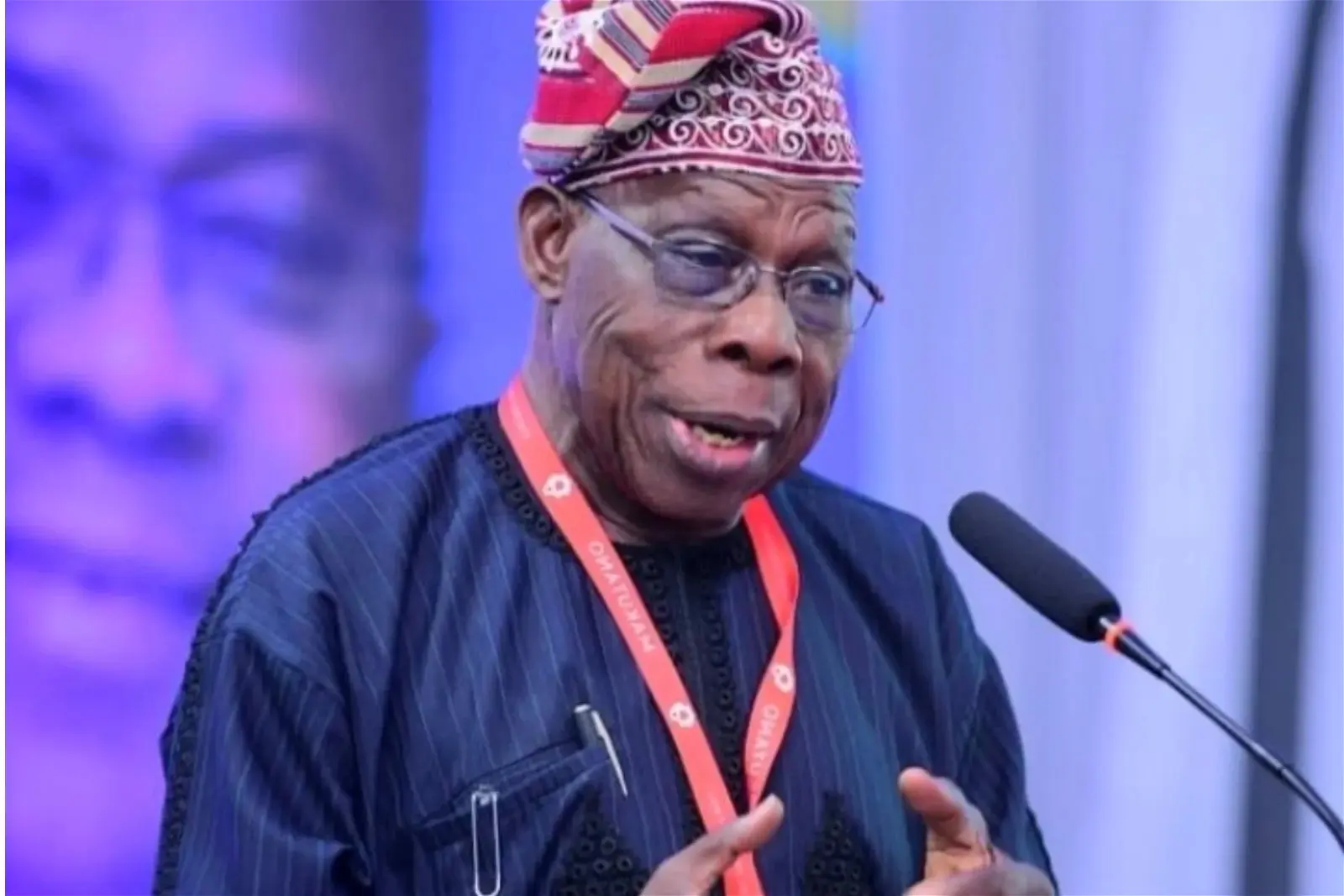
Former President Olusegun Obasanjo has warned that corruption remains a major obstacle to Nigeria’s development, saying its consequences are most severely felt by the poor.
Obasanjo spoke on Monday in Lagos while chairing the public presentation of “Unexplained Wealth: A Trilogy of Nigerian Financial Law,” a three-volume work authored by Senior Advocate of Nigeria, Dr Wahab Shittu.
The former President, who reflected on his long-standing involvement in the fight against corruption, said illicit wealth undermines social and economic progress.


“Whichever way it is described, it is anti-social, it is anti-development, it is anti-progress. It is not in the best interest of any country or any human organisation,” Obasanjo said.
He said his interest in combating corruption began during his military career, when he served as a prosecutor under military law and participated in a court-martial involving corruption.
According to him, his involvement became more pronounced after he left office as military head of state and took up farming, when Peter Eigen, a former World Bank official and later founder of Transparency International, approached him to join the anti-corruption campaign.

Obasanjo recalled that Eigen had witnessed what he described as “grand corruption” during his years at the World Bank, particularly the diversion of funds from loans granted to countries.
“He came to me and said, ‘I want you to join me in fighting corruption.’ I had never met him in my life; I had never known him anywhere,” Obasanjo recalled.
He said he and Eigen subsequently became involved in establishing Transparency International, with Obasanjo serving as chairman of its Advisory Council and Eigen as chairman.
Obasanjo further recalled approaching Bob McNamara, a former United States Secretary of Defence and World Bank president, for support.
According to him, McNamara initially warned that their effort was extremely difficult.
“He said, ‘You two are trying to do the impossible,’” Obasanjo recalled.
He said McNamara nevertheless promised to support the initiative if its founders could demonstrate results.
“He said to us, ‘I will promise you both moral and financial support when you show results,’” he added.
Obasanjo said he and Eigen later travelled across Latin America, Asia and Africa to mobilise support for the anti-corruption campaign.
He said one of their early targets was the Organisation for Economic Co-operation and Development, which, according to him, had permitted companies to deduct bribes paid in corrupt transactions as tax expenses.
“We then decided that the first thing we ought to do is to get OECD not to support money paid for corruption to be deducted for tax purposes,” he said.
He said the campaign lasted almost three years before the OECD abolished the practice, describing the outcome as an important milestone that helped Transparency International gain wider recognition.
Turning to Nigeria, Obasanjo recalled his administration’s efforts to establish the Independent Corrupt Practices and Other Related Offences Commission.
He said Transparency International provided a model anti-corruption law that became the basis for the legislation establishing the ICPC.
“I went to Transparency International, and they gave me a model of a law. And that law that became—or that brought about ICPC,” he said.
According to him, the proposed legislation faced opposition in the National Assembly because some lawmakers feared that its provisions could expose them to prosecution.
“They said to me that if they pass the Bill as I gave it to them, most of them will end up in prison,” he said.
Obasanjo said lawmakers subsequently took 18 months to pass the legislation.
He added that his administration later established the Economic and Financial Crimes Commission to further strengthen the country’s anti-corruption framework.
“Then to strengthen it, I came up with the EFCC,” he said, drawing applause from the audience.
He also praised Nuhu Ribadu, whom he described as a “corruption fighter,” for his role in the establishment and development of the EFCC.
Obasanjo said Shittu’s trilogy was timely because it addressed three important aspects of the fight against illicit wealth: law, prosecution and recovery.
He further recalled that Nigeria had taken some anti-corruption steps before the United Nations adopted its global anti-corruption framework.
“It took about three or four years for the global body, the global organisation, the United Nations, to propose and pass the anti-corruption framework and mandate each country to make laws against corruption. So, we were even ahead of the United Nations,” he said.
Explaining why he accepted the invitation to chair the event, Obasanjo said corruption remained one of the greatest barriers to development.
“When Wahab Shittu, SAN, the author, came to see me and invited me for this occasion, I gladly accepted.
“Because I know one big bane of development of any human organisation, and particularly of a country, one big handicap to development is corruption. Corruption and development are strange bedfellows; they don’t go together.”
He later stressed the disproportionate effect of corruption on vulnerable citizens.
“Those who suffer most in the corrupt society are the poor. And it makes them poorer,” Obasanjo said.
He said corruption had to be prevented from becoming entrenched, noting that no country had completely eliminated the practice.
“There’s nowhere in the world where corruption is totally eliminated. But there are many places in the world where corruption is not allowed to grow,” he said.
Obasanjo urged Nigeria and other African countries to strengthen their laws and institutions and maintain sustained efforts against corruption.
“We cannot make progress in our development as long as we allow corruption to lead,” he said.
Also speaking at the event, the Emir of Kano, Muhammadu Sanusi II, called for political and judicial reforms to complement legal measures against unexplained wealth.
Sanusi warned that anti-corruption laws could have limited impact if investigators, prosecutors and judges failed to apply them fairly and transparently.
“We live in a society where if you have unexplained wealth and if you have the right political cover, nobody asks you. And if you are on the wrong side of politics, you get into trouble,” he said.
Representing former Vice President Yemi Osinbajo, his former Chief of Staff, Ade Ipaye, said asset recovery should be pursued without threatening legitimately acquired wealth.
“What we need now most urgently is a clear, fair, and constitutionally sound approach that can recover what was stolen without threatening what was lawfully earned,” Osinbajo said.
Book reviewer, Prof Olanrewaju Fagbohun (SAN), cautioned against assuming that the absence of conventional documentation automatically meant that wealth was illegally acquired, particularly in Nigeria’s large informal economy.
In his remarks, Shittu said the trilogy was designed to help distinguish legitimate wealth from illicit enrichment.
He said becoming wealthy was not itself a crime, but acquiring wealth through dubious means was.
“Making wealth, becoming rich, is not a crime. It’s not a crime at all. But becoming rich and making wealth dubiously is a crime,” Shittu said.
He added: “The fight against corruption is won not on the day the thief is convicted, but on the day the honest man is believed.”
 We do everything possible to supply quality news and information to all our valuable readers day in, day out and we are committed to keep doing this.
Your kind donation will help our continuous research efforts.
-Advertisement-

-Want to get the news as it breaks?-