
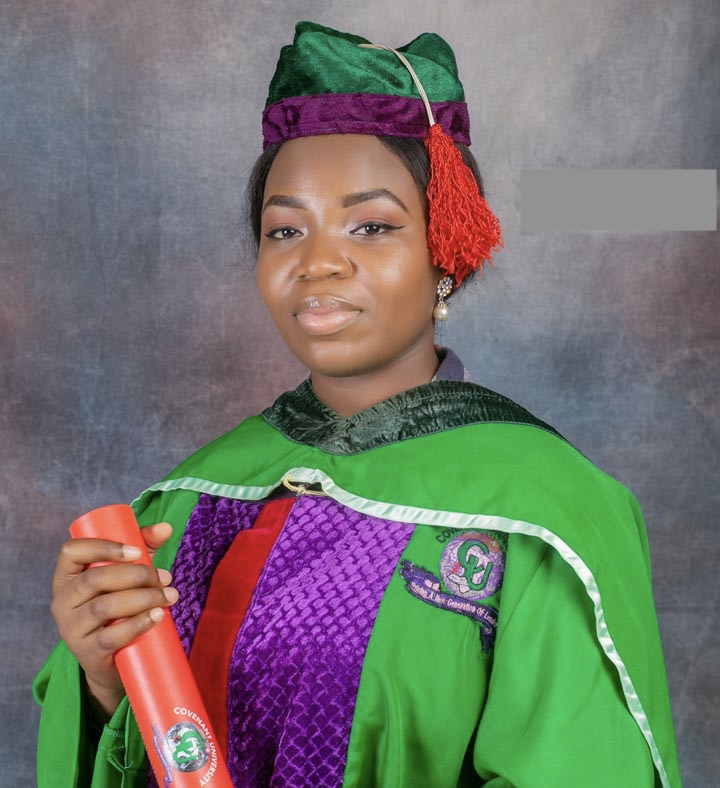
Most of Ajani Comfort Oluwapelumi’s friends call her Pearlz. Pelumi, a Nigerian from Oyo State, loves to explore new things, mainly in Technology, Life sciences, and Tourism. If she were to be a titular character in a story, she would probably be the zealous, strong-willed and clumsy Mulan, because her courage to achieve whatever she sets her mind to do no matter the challenge. This probably accounts for why she emerged the Best Graduating Student in Biology at the convocation of Covenant University Class of 2020.
You had a nearly perfect CGPA, which is very impressive. Can you, in summary, tell us how you accomplished this feat?


I don’t think I can take all the credits without mentioning the God factor, my ever-supportive family, my friends, and the most remarkable learning citadel in Nigeria, Covenant University. Like an average student, I went for classes and burnt my candles pretty well, but only God’s favour helped me attain such CGPA. My parents are lovers of quality education, so my dad paid my tuition fees on loans and his hard-earned savings. Without him, attending Covenant University would have been a myth to me.
I surrounded myself with serious-minded and brilliant people who stood by me during trying times in school. A big thank you to Aderanti Miracle, Bolade Abimbola, Duru Kelechi, Ohanugo Bethel (who taught me how to calculate my CGPA correctly), and many others. Finally, attending Covenant University was one of the most excellent decisions I have ever made. The school did not teach me how to become literate. The school taught me how to discover my inner potentials through various life-changing courses we were introduced to during our undergraduate years. I graduated not just as a first-class graduate but as a person who has seen the value in life-long learning.

Did you set out to study Biology, or was it a course you had to do when you couldn’t get your choice course?
I have always wanted to be a geneticist since my secondary school years because my biology textbook really did an excellent job on that topic. I was really blown away by my imagination on solutions I could provide with Genomic tools. When I started my admission application to Covenant University, I had to look for the closest course to it, which was Applied Biology and Biotechnology (I later found out that I was the only one that voluntarily chose the course). Despite all my exposures to various fields of study, I still do not see myself doing anything outside Life sciences.
Now that you are here, what would you describe as the main attraction for your course?
Biotechnologists and Life scientists, in general, are the unsung heroes of global change in terms of human lives. Every single invention from the pharmaceutical, medical, agricultural, and the field of Artificial intelligence has biotechnology as their major contributor. Sadly, only people who have an interest in the field of biotechnology can know its value. Biotechnology has brought so much to the table than we actually speak of. Talking of the popularly known paternity testing, organ bio-fabrication, crop improvement research efforts, enzyme production, amongst others. I really can’t imagine life without a touch of biotechnology.
READ ALSO: Ondo University Lecturers Sell Students Expensive Handouts For Marks To Survive Nonpayment Of Salaries
Many students would be curious to know how you made it. What sort of student were you (hip, playful, quiet, jovial, or what)?
I would say I had a mixed personality in school. I have always been a very playful person, but when I became committed to graduating as the best student in my course, I had to learn to put my social needs under control when necessary. So I was that kind of student who would be very jovial and lively outside the lecture halls but keep a straight face throughout the lecture period.
Emerging the best graduating student from your course in a prestigious university as CU is something to be proud of. Has your circle of friends increased since your convocation? For instance, new admirers, friend requests on social media, etc.
I wouldn’t say I have gotten more friend requests on social media than expected, but somehow, my story views and post likes have been skyrocketing, with accounts that I can’t even trace. Also, my friends now talk to me with respect, which I find very scary, but we move.
If yes, what has been your reaction to them?
No reactions actually, that is not really where my value is, and besides, I know people always love the spotlight; very few people are interested in the scars.
Often, people assume that brilliant students are unrelenting, boxed-in readers with very little time for play. What do you have to say about that? For instance, how often did you use the library while in school? What were your study habits? What did your social school life look like?
As I have mentioned earlier, I have been the really active and playful one in school. I was an active instrumentalist in the school’s contemporary choir; I attended every social gathering in school, ensured my course organised low-key parties among ourselves; strengthened the bond we shared, and still slept a lot on weekends. Moreover, I still had my study time, took my class projects and assignments seriously, and interacted well in class. I feel this is where the passion comes in. Every time I picked my book to read, I did not see it as a burden; I saw it as a part of me. It wasn’t me reading to pass my exams but ensuring I was acquiring knowledge at a global standard. I stayed long hours in the library only when my room wasn’t conducive for learning in some semesters.
Could you describe your parents/guardians’ role in your academic success? Also, were they insistent on excellence, or that was just something you picked up yourself
My parents are the best support system any student can ever pray for. They would always say, and I quote, “We don’t have money, but the best legacy we can give you is education. It will take you anywhere in the world, so far you take it seriously”. My parents would always counsel my siblings and me for hours till I finally saw the light in what they were saying at a pretty young age. I aspire for excellence anywhere I find myself, and once the fire is dying, they are always there again to counsel me for hours, non-stop!. I failed a couple of times, and the love and support I received from them haunted me to bring out my A-game.
Have you always been an A student? What was your performance like academically in primary and secondary schools?
In my Nursery school, I wasn’t an A student at all; in fact, my parents wanted me to repeat Nursery 2, but a teacher (Mrs. Kehinde) stepped in and offered to give me extra lessons for free. I picked up after her lessons. I was later given a double promotion from Primary 4 to JSS1. I topped the class at age 9, and I continued pretty well till I finished my secondary school education.
What are your plans career-wise? Do you plan to foray into scholastic endeavours (e.g., obtaining higher degrees and lecturing), where will you like to work?
I plan on furthering my studies in Plant biotechnology, to doctorate level, then being more of an advocate of Biotechnology to the younger generation, making them see how great they can become if they study biotechnology. I also plan on having my research laboratory, but I haven’t fully figured out the specific area of plant biotechnology I want to venture into.
Some graduates in public universities are said to get jugs and some ridiculous prizes as rewards for excellence. What has the situation been like in CU? Were you just given cups or plaques? Are there any job offers, monetary prizes, or scholarship opportunities?
There were monetary prizes for the overall best in the department, not courses, which I believe wasn’t fair enough. Fortunately for me, I already prepared my mind for no monetary support, so it did not hit me as a surprise. Moreover, as God would run his things, he gave me a scholarship with Nestle for graduating as a first-class graduate. I wouldn’t disclose the exact amount of the cash prize, but I would say it has inspired me to do better in my Post-graduate studies and also strive for excellence always.
What would you say you did differently from your peers to attain your success?
I wouldn’t say I did anything. Differently, I just had the grace to emerge as the best in the course. I wouldn’t have achieved it. Without my course rep submitting my assignments on due dates, I don’t think my CGPA would be that awesome. Without my course mates coming to choir rehearsal ground to remind me of a test or assignment due that day or waking me up for exams when my alarm clock failed me, I don’t think I would have been privileged to be interviewed by this blog today. I received God’s grace, and I didn’t take it for granted; that’s all really.
If you have to advise students on how to do better in their academics, what will your advice be?
My very first advice would be for them to hold unto God, no matter how impossible succeeding can look at times, God is the only one who can change stories at the very last minute. Also, they need to have a succession plan for themselves. You can only expect from God when you know what you want. I did not have a reading timetable or all those organised people’s advice, but I knew what I wanted out of CU, so I tirelessly pursued it by working smartly. Finally, I would like the direction that they stay disciplined, focused, positive, and determined throughout their stay in CU.
What are your thoughts about Nigeria’s educational system? What can you say has helped in the system? and what would you call outdated or obsolete?
Firstly, I believe Nigeria has been blessed with intelligent and talented youths, so the educational system still produces excellent results, despite the low inputs of the government to optimize this resource. Focusing on growth in the educational sector, the country still has a very long way to go, in terms of providing infrastructure and a better learning environment to the students. Most graduates would have to depend on the SIWES programme in order to gain practical exposure to their field of study, which I believe is not good enough for the employers and the strength of the Nigerian labour market in general. The fact that people still have to depend on old textbooks and outdated schemes of works is devastating. Imagine me reading an article published in 1802 for my exams. Even the species the article was talking about were extinct already, whereas we have new diseases and environmental challenges arising every day and needs immediate solutions. I confronted my lecturer about it, and he said, “That is what the scheme asked us to teach you.” This is why people will graduate from Nigerian Universities and still not be helpful to the labour market until they are trained all over again. I believe things will get better as Nigerian students also see the value in learning and stop relying on just what is taught in class, but having a curious mindset to explore and hunger for quality information from the internet and information platforms.
The Class of 2020 was peculiar with the outbreak of COVID-19 and its attendant impact on education with school closure and the rest. How will you describe the impact on you?
At first, I was really frustrated and depressed. I cried many times because when we started with the online classes, I couldn’t cope due to the power outage in my area and the faulty laptop that I had to use to type my project work. My mental health was at its minimum; I can’t even sugar-coat it.
What were your coping mechanisms?
I had God to always cry upon, and he comforted me with my supportive family members (My brother was always there to set up my system for my zoom classes, anytime I was too tensed to think straight. My mum always prepared my food and kept it in the cooler till I was done with my classes. My sisters kept comforting me anytime I couldn’t hold the frustration anymore and cried out amongst others). I also rubbed minds more with my course mates for our assignments and class projects; it was an exciting and stress-relieving experience with them because they made me know that we were in this together. Above all, I later got used to the hustle and bustle of a final year student in her last semester and sailed through it by God’s grace.
What change would you like to see in Nigeria? Apart from insecurity and corruption, what are other “little foxes” you notice in the system that you think might be hindering the progress of the nation.
I hope to see Nigeria maximize its natural resources optimally. That is one of the major solutions to our economic crises.
If you choose between living in Nigeria and abroad, what would be your choice?
To be sincere, I would spend the youthful phase of my life abroad and gain exposure and skills on how to improve Nigeria. Then come back to the country when I am matured and influential enough to be listened to, and proffer solutions to the government on addressing specific national issues.
Do you think Nigerian scientists are doing enough in the area of research into COVID-19? What do you think they should be doing differently?
I don’t think Nigerian scientists are doing enough in the area of research into COVID-19, and I won’t blame them for that because they are not getting enough monetary and infrastructural support from the government. A lot of articles on various medicinal plants from Nigeria have been published, in a bid to help us embrace our “Phyto-heritage”, but most of these articles are just left unattended to in the database of different Journals. What then is the motivation to keep researching about COVID-19, when 90% of the research work would be funded from international bodies and one’s personal pocket?
My advice is for them to ignore the lack of support from the government and seek for international grants that can cherish their research efforts. They should see the importance of finding a plant-based cure to the virus, which we all know would be biocompatible and safer to administer to the Nigerian medical system.
Some people think CU is tough. What’s your take on this? Did you take to the school’s discipline methods like a fish to water, or did it come as a shock to you owing to your high-school (or previous university) experience?
There is no lie in this, please. CU is extremely tough and draining, but I have found out that my coping mechanism is always seeing the light in whatever the school does, just like I coped in my strict secondary school. For instance, if they ask us not to use our mobile phones, I know they want to curb all distracting calls I can get that might hinder my academic prowess. If they force me to pray often, I ignore the fact that I was forced and focus on the fact that I can have more time to talk to God and get instructions from him. To be sincere, I was amongst those that were really frustrated by the system, but I must say that this same system has made me the awesome person I am today, both spiritually, emotionally, career-wise and so on.
 We do everything possible to supply quality news and information to all our valuable readers day in, day out and we are committed to keep doing this.
Your kind donation will help our continuous research efforts.
-Advertisement-

-Want to get the news as it breaks?-