

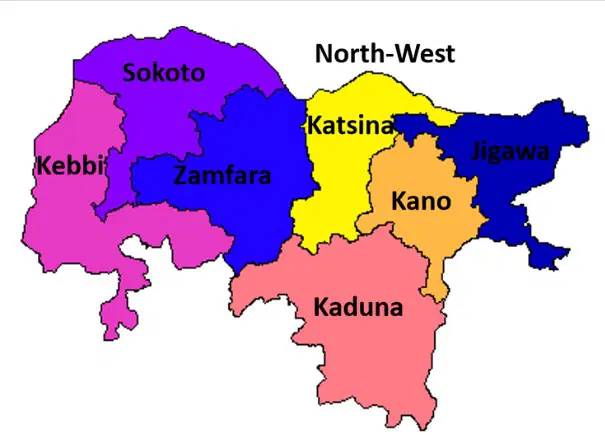

With the February 6, 2027 governorship elections approaching, political activities are intensifying across the North-West as seven incumbent governors prepare to defend their seats against opposition challengers.
The All Progressives Congress (APC) currently controls Kaduna, Jigawa, Sokoto, Kano, Kebbi, Katsina and Zamfara. But the party’s dominance is facing new tests as opposition politicians realign, former allies change camps and the African Democratic Congress (ADC) positions itself as a platform for those seeking an alternative to the ruling party.


The Peoples Democratic Party (PDP) is also hoping to leverage its established grassroots structures and political networks to challenge the APC.
Beyond party calculations, insecurity, unemployment, poverty and the rising cost of living are emerging as critical issues that could shape the outcome of the elections.
In Zamfara, Governor Dauda Lawal faces a politically significant re-election battle after defecting from the PDP, under which he won the 2023 election, to the APC.

His major challenger is Senator Kabiru Marafa of the National Democratic Congress (NDC), while Bulyaminu Yusuf Shinkafi of the ADC and Hamza Musa Maibulawis of the SDP are also in the race.
Lawal is expected to highlight his administration’s infrastructure, education and healthcare projects across the state’s 14 local government areas. He also has the backing associated with the APC and its federal connections.
However, the security situation could become the defining issue of his campaign. Persistent banditry, attacks on communities and the disruption of farming activities have given opposition candidates an opportunity to question the government’s performance.
Marafa is seeking to turn that dissatisfaction into electoral support. His supporters describe him as a politician with a substantial following, while a group known as Marafa Ambassadors for Change has pledged to mobilise support for his ambition.
But the senator must establish a strong statewide structure to compete with the incumbent’s political machinery.
Kaduna’s contest is expected to revolve around Governor Uba Sani’s expanding political coalition and Isa Ashiru’s attempt to secure the governorship for the third time.
Ashiru, who contested against Nasir El-Rufai in 2019 and Sani in 2023, came close to victory in the last election, polling 719,196 votes against the governor’s 730,002.
Sani, however, enters the race with the advantages of incumbency and an expanding network of political allies. His camp includes former governor Ramalan Yero, former senator Shehu Sani, former senator Suleiman Hunkuyi and Senator Sunday Marshall Katung.
The defection of some former El-Rufai associates from the ADC to the APC has also strengthened the governor’s position. Among them are former Finance Commissioner Muhammad Bashir Sa’idu, former Education Commissioner Jafaru Sani and former senator Suleiman Abdu Kwari.
Ashiru’s challenge is to retain the support of opposition figures associated with El-Rufai and prevent political disagreements from weakening his campaign.
Southern Kaduna will be another important factor, particularly over issues of representation, security, development and inclusion in government. The candidates must also convince voters across the state’s three senatorial districts that they can address concerns over agriculture, unemployment, infrastructure, education and healthcare.
In Jigawa, Governor Umar Namadi faces a three-way contest against Mustapha Sule Lamido of the PDP and Senator Sabo Muhammad Nakudu of the ADC.
Namadi is relying on his administration’s development record and the APC’s political machinery. His government is expected to highlight its programmes in infrastructure, agriculture and youth empowerment, while recent defections from opposition parties could strengthen its grassroots network.
Lamido is banking on his family’s political legacy, his appeal among young people and the PDP’s established structures. His father, former Governor Sule Lamido, remains an important figure in the state’s political history.
Jigawa South-West, where the PDP recorded significant victories in the 2023 elections, is expected to be central to his campaign. The movement of two former APC Speakers of the State House of Assembly into the PDP could also improve his prospects.
However, defections from the PDP to the ADC could fragment the opposition’s support base. The controversy surrounding Vice President Kashim Shettima’s assertion that Sule Lamido and other former governors supported the APC has added another dimension to the contest, although the former governor rejected the claim.
Nakudu is hoping to establish the ADC as a credible alternative by capitalising on dissatisfaction with government policies and internal disagreements within the APC.
His major challenge is that he and Lamido come from the same senatorial district, creating the possibility of a divided opposition vote that could favour Namadi.
Sokoto is shaping up as a contest between Governor Ahmed Aliyu of the APC and former Deputy Governor Manir Muhammad Dan’iya of the ADC.
Aliyu has the backing of former Governor and APC leader, Senator Aliyu Magatakarda Wamakko, whose political network remains a major factor in the state. He also enjoys support from serving officeholders, local government chairmen and other influential party stakeholders.
Dan’iya is relying on his experience as a former deputy governor, commissioner and local government chairman, as well as the support of former Governor Aminu Waziri Tambuwal.
The ADC hopes to benefit from public dissatisfaction over insecurity, unemployment and economic hardship. Atiku Abubakar, the party’s presidential candidate, also used his campaign flag-off in Sokoto to promise improved security, the restoration of petroleum subsidy arrangements and better welfare if elected.
However, Dan’iya must translate political endorsements and opposition sentiment into effective grassroots mobilisation and election-day organisation.
The Labour Party’s Haliru Dikko and the NDC’s Shamsuddeen Aliyu Haido are also contesting, but both face organisational and financial limitations compared with the APC and ADC.
In Kano, Governor Abba Kabir Yusuf faces the challenge of managing divisions within the APC while confronting the political consequences of his separation from Senator Rabiu Musa Kwankwaso.
Yusuf, who defected from the NNPP to the APC, enjoys the backing of influential party figures, including former governors Abdullahi Ganduje and Ibrahim Shekarau, and Deputy Senate President Barau Jibrin.
But disagreements involving party stakeholders, including interests associated with Barau and Deputy Governor Murtala Sule Garo, could threaten the unity required for a successful re-election campaign.
The governor’s separation from Kwankwaso and the Kwankwasiyya movement also remains a major political consideration.
His leading challengers are Ibrahim Ali Amin, popularly known as Little, of the ADC and former Deputy Governor Aminu Abdussalam Gwarzo of the NDC.
Little is campaigning on industrialisation, education, healthcare, agriculture, infrastructure and youth and women’s empowerment. He has constituted an 18-member campaign council and secured a favourable court ruling dismissing a challenge to his candidacy.
Gwarzo, however, faces a legal dispute over the recognition of NDC candidates by INEC. The commission retained the party on its updated candidate list with the notation, “Court Order”, following an interim court order in a case challenging the emergence of its candidates.
The NDC has accused the APC of working to prevent its candidates from appearing on the ballot, alleging that the ruling party fears the Kwankwasiyya movement. The APC has denied the allegation and challenged the party to provide evidence.
In Kebbi, Governor Nasir Idris faces former Attorney-General of the Federation, Abubakar Chika Malami, who is seeking the governorship on the ADC platform.
Idris is expected to make road construction, urban development and interventions in critical sectors central to his re-election campaign. His administration has also appointed more than 5,000 aides in different categories, while influential politicians, including Senators Adamu Aliero and Yahaya Abdullahi and former governors Saidu Nasamu Dakingari and Atiku Bagudu, are among his supporters.
Malami is banking on public dissatisfaction over insecurity, particularly attacks on rural communities and the disruption of agricultural activities.
He also hopes to benefit from the ADC’s growing national visibility and has made campaign pledges to civil servants, traditional rulers and traders.
His recent arrests and detention by anti-graft agencies have attracted public attention and sympathy among some sections of the electorate. Nevertheless, he must demonstrate that the ADC can build an effective political structure across the state.
Katsina Governor Dikko Umaru Radda faces a challenge from Senator Yakubu Lado Danmarke of the PDP and Senator Ahmad Babba Kaita of the ADC.
Radda has the advantage of incumbency and the APC’s structures across 34 local government areas and 361 wards. His administration is expected to campaign on road construction, school and healthcare upgrades, agricultural programmes and youth and women empowerment.
But insecurity, unemployment and rising living costs remain potential weaknesses for the governor.
Lado is relying on grassroots connections, humanitarian interventions and his experience in the National Assembly. His supporters point to his empowerment initiatives and assistance to students and less privileged residents.
Babba Kaita is banking on his political experience and constituency interventions, although he must convince voters across the state that he has the leadership qualities and statewide support required to govern.
The broader political picture across the seven states suggests that incumbency alone may not settle the contests.
The APC governors have the advantage of government machinery, political appointments and established networks. Yet their ability to retain power will depend partly on whether they can demonstrate measurable progress in addressing insecurity, poverty and economic hardship.
For the ADC, the challenge is to transform its growing political visibility and the defection of influential politicians into a disciplined grassroots movement. The PDP, meanwhile, must protect its traditional support bases and prevent further defections from weakening its structures.
The February 2027 elections will therefore test not only the popularity of the incumbent governors but also the opposition’s capacity to organise, mobilise voters and protect its votes.
In the end, endorsements, defections and campaign rallies may shape the political atmosphere, but voters’ assessment of governance, security and their economic conditions could prove decisive.
 We do everything possible to supply quality news and information to all our valuable readers day in, day out and we are committed to keep doing this.
Your kind donation will help our continuous research efforts.
-Advertisement-

-Want to get the news as it breaks?-