



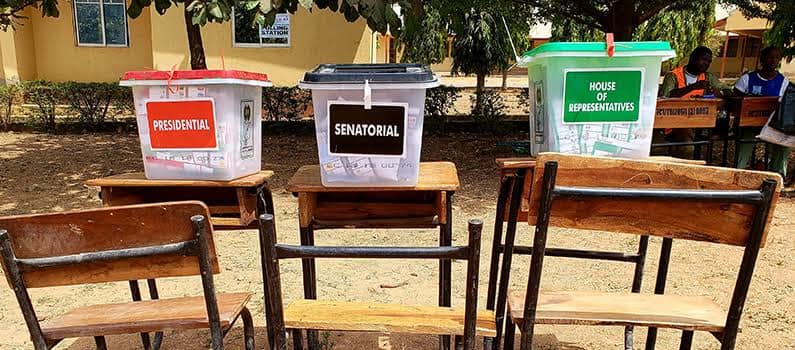

A new survey by Yiaga Africa has revealed that 84 per cent of Nigerians are likely to participate in the 2027 general elections, but insecurity, fear of violence and declining confidence in electoral institutions could undermine actual voter turnout.
The findings were contained in the organisation’s National Voting Intentions Survey 3.0, unveiled in Abuja on Wednesday.


The survey, conducted in September 2026, covered 2,470 Nigerians aged 18 and above across the 36 states of the federation and the Federal Capital Territory.
Of the respondents, 2,066 were interviewed by telephone, while 404 were reached through face-to-face interviews in rural communities.
Although 84 per cent indicated that they were likely to vote, only 47 per cent described themselves as “very likely” to participate.

The survey also identified insecurity as the biggest threat to voter participation, with 82 per cent of respondents expressing concern that violence could affect the 2027 elections.
Similarly, 61 per cent said fear of violence could prevent them from going to polling stations.
Confidence in the Independent National Electoral Commission also declined sharply. Trust in INEC fell from 45 per cent in the first two rounds of the survey to 34 per cent in the latest edition.
By comparison, 49 per cent of respondents said they trusted the technology used in the electoral process, including the Bimodal Voter Accreditation System and the IReV results transmission platform.
The judiciary also recorded a significant confidence deficit, with 63 per cent of respondents saying they had little or no confidence that electoral disputes would be resolved fairly.
The concern was highest in the South-South, where 81 per cent expressed little or no confidence in the resolution of electoral disputes.
The findings come against the backdrop of Nigeria’s historically low voter participation, with only 27 per cent of registered voters reportedly casting ballots in the 2023 general elections.
Speaking on the report, Yiaga Africa Chairman, Board of Trustees, Hussaini Abdu, said the survey was not designed to judge voters or predict the outcome of the 2027 elections but to identify areas requiring urgent intervention.
Abdu described the findings as a wake-up call to political parties, government institutions, civil society organisations and other stakeholders.
“It’s a wake-up call to Nigerians and to civil society organisations, and everyone that is involved in elections, that this election is very important to the country. It’s important for democracy,” he said.
He urged political parties to take responsibility for mobilising voters, warning that low participation could weaken the democratic legitimacy of elected leaders.
Abdu said it was unhealthy for democracy when millions of registered voters stayed away from elections, leaving a relatively small percentage of the electorate to determine who governed the country.
Yiaga Africa’s Head of Knowledge Management and Learning, Safiya Bichi, said the survey challenged the perception that Nigerians were simply apathetic towards elections.
According to Bichi, many Nigerians still want to vote, but fear, distrust and financial considerations could prevent them from converting that willingness into actual participation.
She described the situation as a “conversion problem, not an apathy problem.”
Bichi said urgent steps were required to address the barriers to participation ahead of the presidential election scheduled for January 16, 2027, according to the survey presentation.
The Executive Director of the Peering Advocacy and Advancement Centre in Africa, Ezenwa Nwagwu, also welcomed the 84 per cent voter-intention figure but cautioned INEC against making promises it might struggle to fulfil.
Nwagwu advised the electoral commission to focus on delivering credible elections and to adopt realistic public communication.
He urged INEC to “under-promise and then overperform” in order to rebuild and sustain public confidence.
Yiaga Africa also called on the Federal Government and security agencies to publish a national, threat-based election security plan by November 2026.
The organisation said the plan should be developed through the Inter-Agency Consultative Committee on Election Security, with priority attention to the North-East, North-West and North-Central regions.
It further urged security agencies to shift from a strategy focused mainly on protecting electoral materials to one that prioritises the safety of voters.
Yiaga also called on INEC to make a binding public commitment to real-time uploading of results from all polling units to the IReV platform.
It urged the commission to publish and test its results management protocol, particularly in the South-East and South-South, where concerns over election result management remain significant.
On the judiciary, the organisation called for the speedy resolution of pre-election disputes involving candidates before ballot papers are printed.
It also urged the judiciary to publish clear timelines for determining election petitions.
 We do everything possible to supply quality news and information to all our valuable readers day in, day out and we are committed to keep doing this.
Your kind donation will help our continuous research efforts.
-Advertisement-

-Want to get the news as it breaks?-