




President Bola Tinubu has reaffirmed his commitment to reviving Nigeria’s three government-owned refineries, rejecting concerns that the Port Harcourt, Warri and Kaduna plants may never become commercially viable.
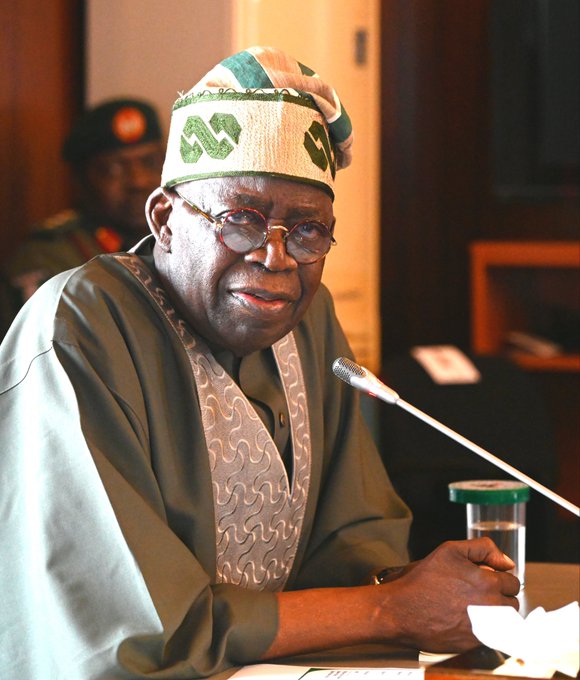
Tinubu made the position clear when he received the Executive President of the Nigeria Union of Petroleum and Natural Gas Workers, Salimon Oladiti, and other union members at the Presidential Villa, Abuja.


The President said the refineries would return to operation but stressed that simply producing smoke and flames would not amount to success unless the facilities became profitable and delivered value to Nigerians.
“The refineries you mentioned are going to come back to work. We’re just building a very firm research and structural reworking of the economy of it. Ordinary flame and smoke of a refinery doesn’t mean it’s working, until it’s profitable and yields the value for which it is built.”
Tinubu also accepted responsibility for resolving the challenges surrounding the inherited facilities, saying he would not dwell on the failures of previous administrations.

“I am not a man who looks back because I have accepted the asset and liability of my predecessor, no matter what has happened in the years past. It is my responsibility now to fix it and make it work for the largest common value of our population. I take responsibility for that, and I’m going to do it.”
The President’s position places his administration at odds with former President Olusegun Obasanjo, who has repeatedly questioned the ability of the Nigerian National Petroleum Company Limited to successfully manage the government-owned refineries.
Obasanjo, speaking in a recent television interview, argued that Nigeria would achieve better results by adopting private-sector-led models for major industrial assets.
He cited the Nigeria Liquefied Natural Gas arrangement, where private investors hold a majority stake, as an example of how public-private partnerships could deliver better outcomes.
“One of the lessons that I learnt is that PPP works. Look, one project that has not been destroyed by the government in Nigeria is the NLNG, where the private sector has 51 per cent, and the Nigerian government has 49 per cent.”
Obasanjo said his administration had previously attempted to bring Shell into the management of the refineries, but the oil company rejected both an equity-based arrangement and a proposal to operate the facilities without taking an ownership stake.
“When I was there, I called Shell. I said, ‘Look, please, I beg you, come and take 10 per cent equity and run the refinery for us.’ They said no. I said, ‘Okay, if you don’t want to take equity, don’t take equity. Come and run the refineries’. They said no.”
According to Obasanjo, Shell’s objections went beyond profitability. He said the company considered the refineries too small by international standards and was concerned about poor maintenance and corruption surrounding their operations.
He also recalled that the Dangote Group, during his administration, offered $750m for a 51 per cent stake in two of the refineries.
“Until one day, Aliko (Dangote) came and offered $750m to take two of the refineries; that will be 51 per cent. I said, ‘Wow, God, you are really a God of miracles.’ I told Aliko to bring the money quickly. They brought the money, and they paid.”
Obasanjo said the transaction was subsequently reversed by the administration of the late former President Umaru Musa Yar’Adua after pressure from the NNPC.
He argued that the reversal deprived Nigeria of an opportunity to transfer the facilities to private management, warning that the plants could eventually lose much of their value.
Obasanjo also raised concerns about the amount spent on refinery rehabilitation over the years, claiming that about $16bn had been committed to efforts to revive the facilities.
The debate has also drawn criticism from the business community. Aliko Dangote, who eventually established his own refinery after his group’s earlier acquisition of government refineries was reversed, has previously questioned the sustainability of repeatedly rehabilitating ageing plants.
Dangote likened the turnaround maintenance strategy to upgrading an old vehicle with modern technology while leaving its ageing structure intact.
“(The turnaround maintenance) is like you trying to modernise a car that was built 40 years ago, when technology and everything have changed. Even if you change the engine, the body will not be able to take the shock of that new technology engine.”
Expert Opposes Further Rehabilitation
Energy expert Dan Kunle has also urged the Federal Government to stop committing public funds to the old refineries, arguing that previous rehabilitation efforts had failed to produce sustainable commercial operations.
Kunle said the President might be relying on information supplied by managers of the facilities and questioned the accuracy of such information.
“Logically, let us just say the information at the disposal of the President on those refineries, I’m sure, was as presented to him by the managers of those refineries. I can tell you those pieces of information are not the truth. They are driven by self-interest.”
He maintained that Nigeria had repeatedly attempted to revive the refineries without achieving sustained profitability.
“Because we have passed through that road before, those refineries will never work. If they ever work, they will not work at profit. They will remain problematic.”
Kunle proposed a direct comparison between an old government refinery and a newly constructed plant to demonstrate the difference in operational and financial performance.
“If they want to bet it, let the president get an investor to build a new refinery by the side of Warri or Port Harcourt refinery. Let them run the old one by the side and run the new one on the other side, and they will see what we are talking about.”
He further advised the administration to redirect public resources towards sectors such as education, agriculture, gas infrastructure and other areas capable of attracting investment and creating economic opportunities.
“But for him to take his power to still be concentrating on those refineries that have been technically insolvent for the last 25 years is very strange.”
Kunle also questioned why successive administrations had failed to deliver on repeated promises to restore the refineries despite billions of dollars reportedly spent on rehabilitation.
“They convinced Umar Yar’Adua to cancel the privatisation; he did. They convinced Goodluck Jonathan that they could fix. They convinced Muhammadu Buhari that they could fix the refinery. None of them have achieved it. So, what makes President Tinubu think that in the next four years, he can fix those refineries and make them profitable?”
Host Communities Back Tinubu
Despite the criticism, the Port Harcourt Refinery Host Community Bulk Petroleum Retailers Association has backed the Federal Government’s plan to revive the facility.
The association said the successful and sustained operation of the Port Harcourt refinery would have significant economic consequences for communities and businesses that depend on the facility.
HOSCOM estimated that more than 200,000 people depend directly and indirectly on the refinery and related economic activities.
It also supported the proposed technical equity partnership between the NNPC and Chinese companies for the rehabilitation and expansion of the Port Harcourt and Warri refineries.
The association, however, stressed the need for reliable crude supply, competent management, proper maintenance and technical expertise if the facilities are to remain operational.
HOSCOM went further by pledging political support for Tinubu if the Port Harcourt refinery becomes fully operational before the 2027 general election.
“The association further pledges to work towards doubling the votes President Tinubu received in Rivers State in the last election, should the Port Harcourt Refinery become operational before the election.”
 We do everything possible to supply quality news and information to all our valuable readers day in, day out and we are committed to keep doing this.
Your kind donation will help our continuous research efforts.
-Advertisement-

-Want to get the news as it breaks?-