



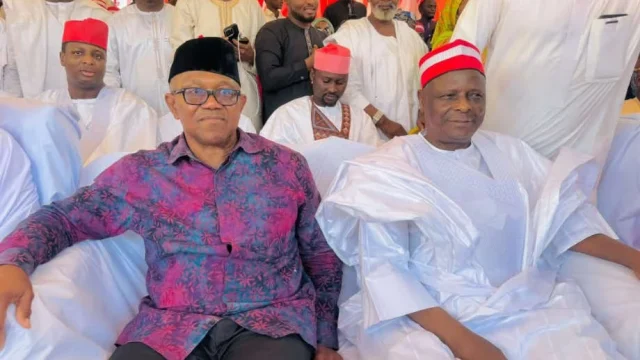

Former Kano State Governor, Rabiu Kwankwaso, has said national interest, political balance and the need for change influenced his decision to join Peter Obi as the vice-presidential candidate of the National Democratic Congress ahead of the 2027 presidential election.
Kwankwaso, who spoke on Sunday during the News Agency of Nigeria Personality Interview Series in Abuja, said his decision to accept the number-two position was not motivated by a desire for political office but by what he described as the broader interests of Nigeria.
The former governor said his assessment of Obi had changed considerably since the 2023 presidential election, when both politicians explored a possible alliance.


According to him, four years of further interaction and political experience had given him greater confidence in Obi’s character and capacity.
“People learn every day, and that is why experience is very important. In 2023, we attempted to work together and at that particular point, I knew little about Peter Obi.
“But over these last four years, I was able to learn a lot and realised that Peter is somebody that I could work together with,” he said.

Kwankwaso said consultations with members of the Kwankwasiyya Movement, supporters of the New Nigeria Peoples Party and the Obidient Movement also contributed to the decision.
He said the consultations reinforced the argument for a ticket that would bridge the country’s regional divide and offer what he described as a credible alternative to Nigerians.
The former defence minister also pointed to insecurity, declining agricultural productivity, deteriorating infrastructure and economic hardship as factors behind his support for the alliance.
He said the problems were particularly severe for farmers in Northern Nigeria, where insecurity and rising production costs had made agriculture increasingly difficult.
Kwankwaso argued that the country needed the kind of political change Nigerians demanded in 2015, insisting that the circumstances confronting the country had made such a change even more necessary.
He described the Obi-Kwankwaso ticket as a combination of regional balance, competence and credibility.
“Nobody, no ticket can beat our own in terms of credibility, in terms of capacity and of course, in terms of love for the country; even in terms of empathy for the poor that are suffering across the country today,” he said.
Why Kwankwaso Accepted The Deputy Role
Kwankwaso also rejected the perception that accepting the vice-presidential slot represented a political downgrade for a man who has served as governor, senator, minister and deputy speaker of the House of Representatives.
He said public office should be viewed primarily as an avenue for service rather than personal advancement.
“I have never been the vice president. I think it is a step forward despite all the things you counted,” he said.
The former governor added that he did not consider the presidency or vice-presidency a personal entitlement.
“To me, being in government is to serve. I don’t have to be president. I don’t have to even be vice president. These are things that are in the hands of Almighty Allah.
“But the fact remains that the situation, as it is today, one has to look at it beyond your humble self,” he said.
Kwankwaso said the understanding reached with Obi was that the South would retain the presidency for one term before the political arrangement returned to the North.
He said the agreement was important to his supporters because it addressed concerns about regional balance and the future political interests of the North.
The former governor also cited the example of the late Premier of Northern Nigeria, Sir Ahmadu Bello, who, according to him, demonstrated that political service should not always be measured by occupying the highest office.
Kwankwaso Warns Against Political Betrayal
While explaining his decision to work with Obi, Kwankwaso also turned his attention to former political allies in Kano, particularly former governor Abdullahi Ganduje and incumbent Governor Abba Yusuf.
He maintained that political relationships built on betrayal rarely produce lasting success, arguing that politicians who abandon the structures that helped them rise eventually lose influence.
“You cannot succeed with treachery. I have not seen one. Now we have taken about two and a half decades,” he said.
Kwankwaso specifically cited Ganduje, who served as his deputy governor for eight years before succeeding him as governor in 2015.
He argued that Ganduje’s political fortunes declined after their relationship broke down.
“If you can even see the issue of Ganduje, who we came together and supported, and became governor free of charge. The day when he started fighting was the beginning of his problem. If I may ask: where is he now? It is difficult to see him,” he said.
Kwankwaso also criticised Yusuf, whom he said was selected by the Kwankwasiyya political structure after extensive efforts to ensure that he emerged as the group’s candidate.
He recalled that the group backed Yusuf in the 2019 governorship election and again supported his successful bid in 2023.
“Abba Yusuf: we went down, right down, to make sure that we picked the right person who would not go and repeat what Ganduje had done,” he stated.
According to Kwankwaso, the relationship subsequently changed after Yusuf became governor.
“He left us, but he is not with Ganduje now. He is in between because I don’t think he is happy for anybody to call him Dan Gandujiyya,” he said.
He accused Yusuf of attempting to establish an independent political base in Kano while distancing himself from the structure that supported his emergence.
Kwankwaso said the development was another example of the transient nature of political alliances in Nigeria.
Tinubu Reconciliation Efforts
Kwankwaso also disclosed that President Bola Tinubu had previously encouraged him to reconcile with Ganduje.
The former governor said he responded by pointing to the changing fortunes of some of Tinubu’s former political associates.
“I told him that when I come here, I don’t see Bucknor. When I come here, I don’t see Ambode. I started counting the people,” he said, referring to former Lagos State Deputy Governor Kofoworola Bucknor-Akerele and former Governor Akinwunmi Ambode.
He said political relationships could change dramatically despite years of collaboration.
Kwankwaso, however, singled out former Osun State Governor, Bisi Akande, as one of the political figures he still regarded as a friend.
“It’s not very peculiar to Kano, but I think the Kano experience is special out of the general lots,” he said.
Confidence In Obi-Kwankwaso Partnership
Kwankwaso said his experience as a former deputy speaker, governor and minister had also shaped his expectations of the proposed presidency.
He said a vice-president should not be treated as a ceremonial figure but should be given meaningful responsibilities to contribute to governance.
“Power will be shared according to the needs of the country. We should not be in a hurry to go and take anybody on the streets or anybody we remember.
“We will make sure that we have competent people because from our experience, the president and vice president cannot do it alone,” he said.
 We do everything possible to supply quality news and information to all our valuable readers day in, day out and we are committed to keep doing this.
Your kind donation will help our continuous research efforts.
-Advertisement-

-Want to get the news as it breaks?-