



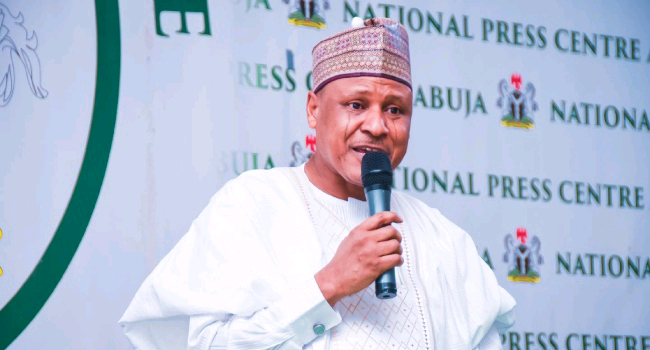

The Minister of Information and National Orientation, Mohammed Idris, has warned Nigerian editors that the growing ability to create convincing false content with artificial intelligence could undermine public trust and the credibility of the 2027 elections.
Idris gave the warning in an address delivered at the 2026 All Nigeria Editors Conference in Enugu on Thursday, where he said the challenge posed by AI-generated photographs, videos, audio recordings and documents had gone beyond ordinary misinformation.
The conference, organised by the Nigerian Guild of Editors, is themed, “The Ballot, the Media and the Task of Keeping Democracy Alive,” with the sub-theme, “When Lies Look Real: Detecting and Debunking AI Disinformation Before, During and After Election.”


With Nigeria’s 2027 general elections approaching, Idris said citizens must have access to credible information to make informed decisions.
According to him, editors occupy a critical position because they determine what enters public discourse, which issues receive attention and how stories are framed across traditional and digital platforms.
He warned that AI could make fabricated material appear authentic, including cloned voices of public officials, manipulated videos and old photographs presented as recent events.

The minister said the greater danger was not only that citizens might believe false information but that they could eventually lose confidence in genuine information.
He therefore urged newsrooms to make verification part of their everyday culture rather than treating fact-checking as an exercise conducted after publication.
Idris advised editors and reporters to establish who made a claim, identify the evidence supporting it, verify when and where photographs were taken, determine whether videos are original and independently confirm information before publication.
He also urged journalists to ensure headlines accurately reflect stories and to clearly distinguish between facts, allegations and opinions.
The minister said the media must apply the same rigorous standards when reporting the performance of government.
He noted that the President Bola Tinubu administration had introduced major economic reforms, including petrol subsidy removal and changes to the foreign exchange system, while the Federal Government had reported increased revenue mobilisation, stronger investor confidence and greater resources for states and local governments.
Idris also cited government-reported investments in infrastructure, education, human capital development, digital connectivity and other sectors.
He, however, cautioned against either exaggerating government achievements or ignoring them.
“A responsible press should neither exaggerate achievements nor ignore them. It should examine them, verify them, ask difficult questions, and allow citizens to understand both the progress and the shortcomings,” he said.
On electoral reforms, Idris said amendments to the Electoral Act signed into law in February 2026 deserved careful public scrutiny, regardless of political affiliation.
He urged the media to explain the changes and their implications for political parties, candidates, voters and election administrators in language ordinary citizens could understand.
The minister further warned journalists against becoming participants in political contests.
“The job of the professional journalist is not to amplify every claim simply because it is politically attractive. The job is to establish what is true, provide context and allow citizens to make their own judgments,” he said.
He called for stronger collaboration between newsrooms, fact-checking organisations, technology experts, electoral authorities and other credible institutions ahead of the elections.
Idris also urged media organisations to invest in digital verification skills and establish clear procedures for dealing with AI-generated material.
He said the Federal Ministry of Information and National Orientation was working with UNESCO on media and information literacy initiatives to help citizens navigate the increasingly complex information environment.
He said the responsibility extended beyond election-day coverage to governance at all levels, including the 774 local government councils.
Idris said journalists should track how public resources are used, monitor projects and report whether citizens receive the services to which they are entitled.
He concluded that the media’s responsibility ahead of 2027 extended beyond protecting the credibility of an individual election.
“The task before us is bigger than protecting the credibility of one election. It is about protecting the credibility of our democracy,” he said.
He urged editors to help create an information environment in which Nigerians can find, verify and trust facts when they go to the polls.
“The ballot belongs to the people. The responsibility of the media is to help ensure that the information surrounding that ballot is worthy of a democracy,” Idris said.
 We do everything possible to supply quality news and information to all our valuable readers day in, day out and we are committed to keep doing this.
Your kind donation will help our continuous research efforts.
-Advertisement-

-Want to get the news as it breaks?-