





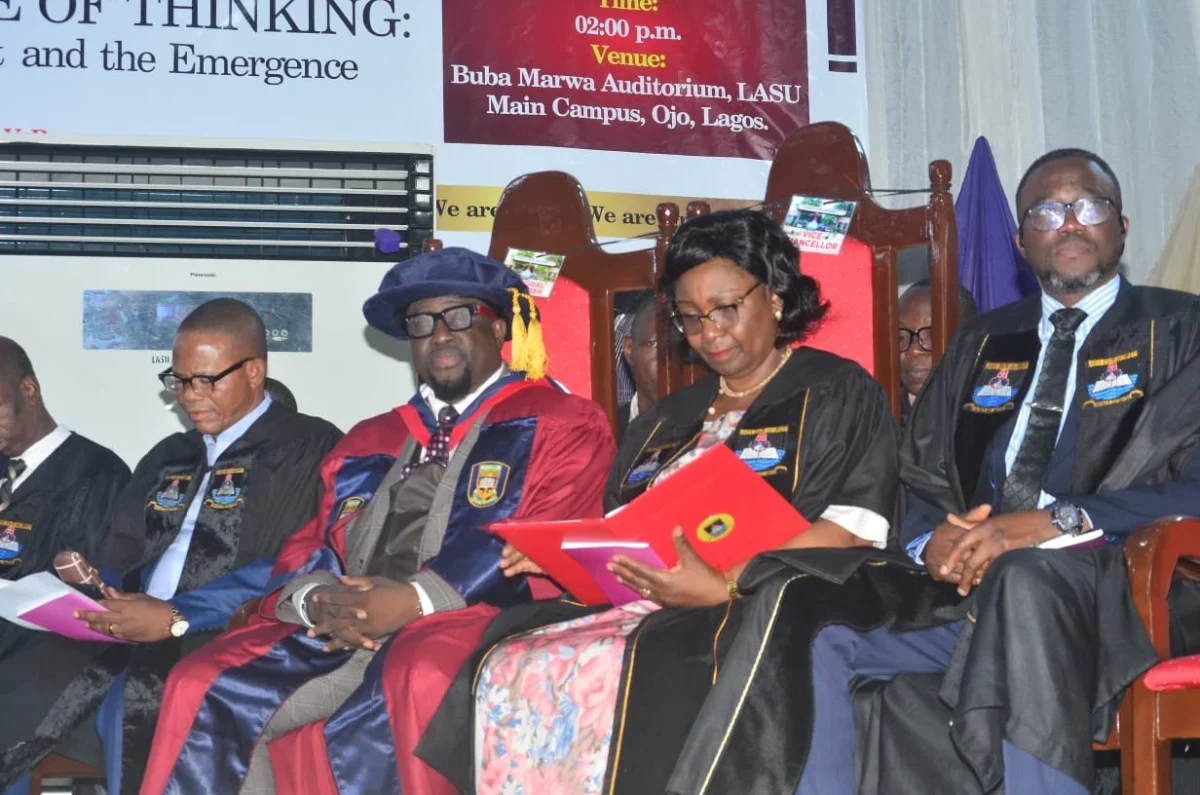

Artificial Intelligence is no longer simply a tool for automating tasks. It is increasingly becoming a partner in how people learn, process information and make decisions—a shift that could fundamentally transform education in Nigeria.
This was the central message of a lecture delivered by Professor Enikuomehin, who examined the changing relationship between human intelligence and machines and challenged educators, policymakers and citizens to prepare for an era in which learning is increasingly shaped by AI.
“In those few minutes, something subtle but important had already happened. I had begun my day not by thinking alone, but by thinking with a machine,” he said, illustrating how quickly AI is becoming embedded in everyday intellectual activities.
According to the professor, the growing influence of AI presents both an opportunity and a challenge for education. While intelligent technologies can personalise learning, expand access to knowledge and support teachers, they can also influence how students think, what information they encounter and how they arrive at conclusions.


He therefore warned that education systems must ensure that students do not simply learn how to use AI, but also how to think critically with it.
“Success will depend not on competing with machines but on developing the uniquely human capacities that enable meaningful collaboration with them,” Enikuomehin said.
He urged Nigerians to question and verify AI-generated information, rather than accepting machine-produced answers uncritically. For students in particular, he said independent thinking, ethical judgement, creativity and the ability to interrogate information would become increasingly important as AI becomes more sophisticated.

Rethinking education in the age of AI
The professor argued that the emergence of AI requires a rethink of what is taught in schools and universities—and how learning itself is assessed.
Rather than designing education around the ability to memorise information, institutions will need to place greater emphasis on problem-solving, critical thinking, creativity, collaboration, digital literacy and ethical reasoning.
This, he suggested, means that AI should not be viewed merely as another technology to be introduced into classrooms. It should prompt a broader conversation about the purpose of education in a society where machines can increasingly generate information, analyse problems and produce written work.
The challenge for educators, therefore, is to ensure that technology enhances learning without weakening the intellectual independence of learners.
Governance is also an education issue
To support responsible use of AI, Enikuomehin unveiled what he called the AI Governance Stack, a seven-layer framework covering infrastructure security, data governance, algorithmic accountability, explainability, ethical oversight, regulatory compliance and societal impact assessment.
“AI governance is a layered problem. Failure at any layer propagates upward and undermines the layers above it,” he said.
He explained that even an AI system with strong ethical safeguards could produce harmful or discriminatory outcomes if the data on which it operates is poorly governed.
For Nigeria’s education sector, this has direct implications. AI systems increasingly used in learning, assessment and student support must be transparent, accountable and designed to protect learners’ data.
Enikuomehin called for a comprehensive legislative framework that clearly defines the governance requirements at each layer of AI deployment. He also proposed an independent National AI Research and Governance Council to examine the social impact of AI, advise government on policy and represent Nigeria in international AI governance discussions.
The digital divide could become a learning divide
But responsible AI adoption, he warned, cannot happen without addressing Nigeria’s digital infrastructure gap.
Universal broadband, affordable digital devices and reliable electricity, he argued, are essential if AI is to expand educational opportunity rather than reinforce existing inequalities.
“Without universal broadband, affordable device access and reliable electricity, AI will deepen the inequalities it promises to address,” he warned.
For schools and universities, this means that AI adoption cannot be measured simply by how many institutions have access to AI tools. The more important question is whether students—regardless of location or socioeconomic background—can access the infrastructure needed to benefit from them.
Protecting the learner in an AI-driven society
Enikuomehin also urged Nigerians to take digital identity and privacy seriously as technology becomes increasingly embedded in everyday life.
“Our memories are stored in the cloud, our decisions are influenced by algorithms, and our knowledge is increasingly co-created with machines,” he said.
He described personal data as a “cognitive shadow” and argued that protecting digital privacy should be understood not merely as a technical concern but as part of protecting human dignity.
For students, this raises important questions about how educational platforms collect, store and use personal information—and how much control learners should have over their digital identities.
Universities must lead the transition
The Vice-Chancellor of Lagos State University, Prof. Ibiyemi Olatunji-Bello, described the lecture as “a very stimulating lecture,” noting that it offered insights into the evolution of human thought in an era increasingly shaped by Artificial Intelligence.
She said the presentation explored the movement from human thinking to machine thinking and examined how AI, augmented systems and cyber-physical technologies are reshaping cognition and creating what she described as a new algorithmic society.
Olatunji-Bello also announced that Enikuomehin would become the first inaugural lecturer to receive the university’s newly introduced commemorative certificate for inaugural lecturers.
“As an honour, you are the very first inaugural lecturer who will be given a commemorative certificate. You have been officially welcomed into the Senate and the Body of Professors,” she added.
Ultimately, the lecture presented AI not simply as a technological revolution, but as an educational turning point.
The question for Nigeria is no longer whether young people will encounter AI. They already have.
The more important question is whether the country’s schools and universities will equip them to use it without surrendering the curiosity, judgement, creativity and independent thinking that make education meaningful.
 We do everything possible to supply quality news and information to all our valuable readers day in, day out and we are committed to keep doing this.
Your kind donation will help our continuous research efforts.
-Advertisement-

-Want to get the news as it breaks?-






