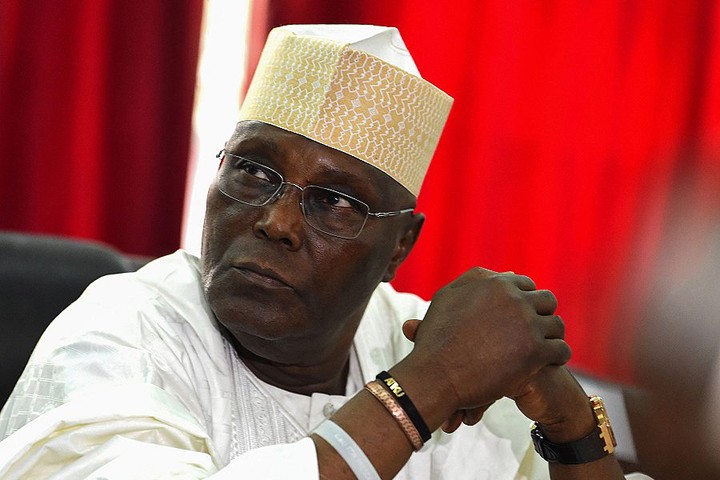

Former Vice-President Atiku Abubakar has criticised the economic policies of President Bola Tinubu, arguing that declining household purchasing power is making home ownership, vehicle purchases and other major acquisitions increasingly difficult for Nigerians.
Atiku, the African Democratic Congress, ADC, presidential candidate, made the assessment in a statement issued on Saturday by his Senior Special Assistant on Public Communication, Phrank Shaibu.
He based his argument on the latest household expectations survey of the Central Bank of Nigeria, which recorded weak consumer sentiment towards major purchases, including motor vehicles, consumer durables, buildings and landed property.


According to the figures cited by Atiku, buying conditions stood at 28.7 points for motor vehicles, 28.9 points for consumer durables and 30.0 points for buildings and landed property.
The survey also recorded willingness-to-buy scores of 18.7 points for vehicles and 19.2 points for buildings and landed property, figures Atiku said reflected the financial pressures confronting households.
“These are not figures manufactured by the opposition. They are the verdict of Nigerian households captured by the Central Bank under President Tinubu’s own government,” Atiku said.

He argued that the figures showed that the economic challenge had moved beyond the cost of food to affect Nigerians’ ability to acquire assets and improve their living standards.
“What the figures tell us is simple: Nigerians are being priced out of decent living. A home is becoming a fantasy. A car is becoming a luxury. Household appliances are increasingly beyond reach,” he said.
According to the former vice-president, families are committing a growing share of their earnings to basic expenses such as food, transportation, electricity and school fees, leaving little disposable income for savings, investment or asset acquisition.
Atiku linked the CBN findings to the latest SBM Intelligence Jollof Index, which he said further demonstrated the pressure on household budgets.
He cited the index as putting the average cost of ingredients for a pot of jollof rice for a family of five at ₦29,578.
Atiku said the figure was particularly significant for workers earning the ₦70,000 minimum wage, arguing that the cost of one meal could consume more than 40 per cent of monthly earnings before other essential expenses were considered.
“Only recently, the Jollof Index told us what Tinubu’s economy has done to the Nigerian kitchen. Now the CBN survey is telling us what it has done to the Nigerian dream,” he said.
The former vice-president accused the Federal Government of placing greater emphasis on macroeconomic indicators while household purchasing power remained under pressure.
He said Nigerians were increasingly being forced to make difficult choices over everyday expenses, adding that weak demand for houses, vehicles and household goods could also affect businesses and broader economic activity.
“An economy is not successful merely because government officials can quote favourable statistics. An economy succeeds when citizens can work, earn, eat, save, invest and progressively improve their standard of living,” Atiku said.
He urged the Tinubu administration to focus more directly on household welfare and purchasing power in assessing the impact of its economic reforms.
“Before there is GDP, there must be dinner. Before there is prosperity, there must be purchasing power. And before a government congratulates itself on reform, ordinary citizens must be able to see and feel improvement in their own lives,” he said.
Atiku also criticised what he described as reliance on favourable economic statistics without sufficient attention to the experiences of ordinary households.
“President Tinubu should stop governing Nigeria through PowerPoint economics. The real economy is the Nigerian family’s pocket, and that pocket is increasingly empty,” he added.
He maintained that the ability of Nigerians to afford food, housing, transportation and other basic necessities should remain a central measure of the success of government economic policies.
 We do everything possible to supply quality news and information to all our valuable readers day in, day out and we are committed to keep doing this.
Your kind donation will help our continuous research efforts.
-Advertisement-

-Want to get the news as it breaks?-