




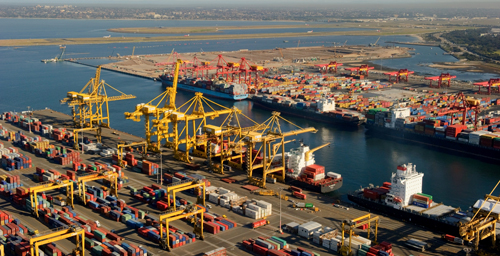

China supplied goods worth N11.01tn to Nigeria in the first six months of 2026, accounting for 39.27 per cent of the country’s total imports during the period, according to the latest foreign trade data released by the National Bureau of Statistics.
The figure represents a significant increase in Nigeria’s dependence on Chinese imports despite a decline in the country’s overall import bill.


An analysis of the NBS Foreign Trade in Goods Statistics showed that imports from China increased from N5.10tn in the first quarter of 2026 to N5.92tn in the second quarter.
Combined, the N11.01tn imported from China represented almost four out of every 10 naira spent on imported goods by Nigeria between January and June.
The figure was also higher than the N9.62tn recorded in the corresponding period of 2025, when China accounted for 29.03 per cent of Nigeria’s N33.14tn total imports.

Thus, Chinese imports increased by N1.39tn, or 14.49 per cent, year-on-year, while Nigeria’s overall import bill fell by N5.10tn, or 15.37 per cent.
The widening gap pushed China’s share of Nigeria’s imports up by more than 10 percentage points within one year.
China remained Nigeria’s biggest source of imported goods in the first quarter, supplying N5.10tn, or 37.42 per cent, of the N13.62tn total import bill.
The United States followed with N2.81tn, while India supplied N992.87bn.
China’s dominance became even more pronounced in the second quarter, when its exports to Nigeria rose by 16.09 per cent to N5.92tn.
That represented 41.02 per cent of Nigeria’s N14.42tn imports during the quarter.
By comparison, the United States supplied N1.01tn, representing 6.97 per cent, while India accounted for N924.46bn, or 6.41 per cent.
The Netherlands and Germany supplied N409.81bn and N395.87bn, respectively.
The NBS figures showed that Nigeria’s imports from China in the second quarter alone were almost six times the value of goods imported from the United States.
Compared with the same quarter in 2025, Chinese imports increased by N955.58bn, or 19.26 per cent, from N4.96tn.
The rising volume of Chinese imports comes amid renewed concerns over counterfeit and substandard products in the Nigerian market.
Public concern over fake products has intensified in recent months, with Nigerians and social media personalities raising alarms over allegedly counterfeit toothpaste, creams, bottled water and yoghurt drinks.
NAFDAC’s Director of Investigation and Enforcement, Martins Iluyomade, said the agency had identified a new pattern involving Chinese-linked counterfeit operations in Nigeria.
He said some operators now identify popular products in the Nigerian market, arrange for them to be replicated and subsequently use logistics networks to distribute the fake products.
“Before, to fake a product, you needed to go to China to bring it. Now, you don’t need to go. They are here (in Nigeria) with us. They are the ones who will identify the product that will be moving, send it to their country (China), and then come here and distribute it to our people (Nigerians) without having to travel.
“Describing it as a “new trend making it (fake goods situation) look this serious,” he noted that NAFDAC discovered the “Chinese people (counterfeiters) own the logistics companies which they used to bring these (fake goods) things.”
NAFDAC has consequently been shutting down logistics companies allegedly connected to the distribution networks as part of efforts to disrupt the counterfeit trade.
However, the agency’s concerns do not mean that the entire N11.01tn worth of goods imported from China were counterfeit.
Rather, the size of the trade highlights the scale of the supply chain requiring regulatory monitoring both at the borders and within Nigeria.
China’s dominance was particularly strong in Nigeria’s trade with Asia.
Asian countries supplied N7.55tn worth of goods in the first quarter and N8.56tn in the second quarter, bringing total Asian imports to N16.12tn in the first half of the year.
China alone accounted for 68.34 per cent of those imports.
The major Chinese imports included telecommunications equipment and machines for receiving, converting and transmitting voice, images or data, valued at N254.41bn in the first quarter.
Seeders, planters and transplanters accounted for N137.94bn, while parts of equipment for transmitting or receiving voice, images or data were valued at N104.53bn.
Nigeria also imported N103.83bn worth of herbicides and related agricultural products and N81.15bn of line pipes for oil and gas pipelines.
In the second quarter, photovoltaic cells assembled into modules or panels were among the major imports from China, valued at N184.02bn.
Other major items included telecommunications equipment worth N158.73bn, machinery with a 360-degree revolving superstructure valued at N152.56bn, herbicides worth N128.88bn and machinery for cleaning, sorting or grading seeds and grains valued at N126.45bn.
The figures underline China’s growing importance to Nigeria’s telecommunications, agriculture, construction, renewable energy and industrial sectors.
Meanwhile, Nigeria’s manufactured goods imports also increased significantly.
Manufactured imports rose to N8.48tn in the first quarter, representing a 12.94 per cent increase from N7.51tn recorded in the corresponding quarter of 2025.
The figure climbed further to N9.51tn in the second quarter, up 20.65 per cent from N7.88tn a year earlier.
In total, Nigeria imported N18tn worth of manufactured goods in the first half of 2026, representing 64.16 per cent of its total imports.
The trade imbalance with China was equally pronounced.
Nigeria exported goods worth N582.20bn to China in the first quarter and N506.57bn in the second, bringing total exports to N1.09tn.
Against imports of N11.01tn, the figures imply an estimated N9.92tn merchandise trade deficit with China.
In effect, Nigeria imported about N10.11 worth of goods from China for every N1 worth of goods it exported to the country.
Nigeria’s exports to China represented only 2.26 per cent of the country’s total exports of N48.19tn during the period.
NAFDAC has meanwhile stepped up enforcement against counterfeit and substandard products.
The agency said it secured 64 convictions for counterfeiting offences between June 2025 and June 2026, while its enforcement operations led to the seizure and destruction of large quantities of unregistered and fake products.
NAFDAC Director-General, Prof Mojisola Adeyeye, also said the agency had seized or destroyed more than N1.54tn worth of fake and substandard regulated products across the country since 2023.
The growing counterfeit trade has also raised concerns among local manufacturers.
Vice Chairman of the Lagos Chapter of the National Association of Small-Scale Industrialists, Peter Popoola, said counterfeit products were reducing sales, damaging legitimate brands and threatening jobs.
“Counterfeiting reduces our sales and profits. It also damages the reputation of legitimate brands because the consumer may not know the difference until he uses the product and it turns out bad,” Popoola said.
He added that many small businesses could not afford the cost of protecting their products or pursuing legal action against counterfeiters.
“The cost of protecting our products and taking possible legal action is high. SMEs’ finances are generally limited; we cannot afford it. It slows down our growth and leads to job losses,” he stated.
Popoola blamed weak political will, corruption and poverty for fuelling the counterfeit market, while calling for government-backed grants, low-interest credit and consumer financing to make genuine products more affordable.
Chief Executive Officer of Spectra Industries Limited, Duro Kuteyi, similarly linked the growing demand for counterfeit products to declining household purchasing power.
“There is not much money in the pocket, so everybody is looking for cheap items, and that is where counterfeiters gain access to the market,” Kuteyi said.
He urged consumers to pay attention to warning signs such as poorly positioned labels and other inconsistencies when purchasing products.
 We do everything possible to supply quality news and information to all our valuable readers day in, day out and we are committed to keep doing this.
Your kind donation will help our continuous research efforts.
-Advertisement-

-Want to get the news as it breaks?-