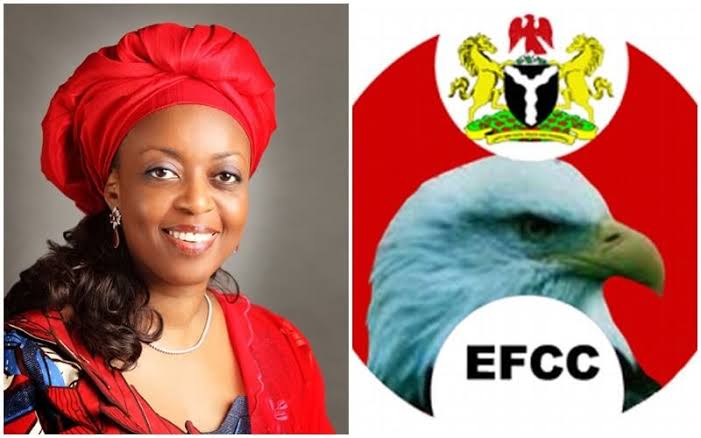

The Federal High Court in Abuja has granted former Minister of Petroleum Resources, Diezani Alison-Madueke, permission to rely on her recent acquittal by a United Kingdom court in her legal challenge against the Economic and Financial Crimes Commission (EFCC) over forfeited assets.
Justice Inyang Ekwo gave the approval on Wednesday after allowing an application seeking to introduce additional evidence based on the judgment delivered by the Southwark Crown Court in London.
Diezani’s counsel, Godwin Iyinbor, argued that the UK decision was a significant development that occurred after the suit had already been filed and should be considered in determining the case.


The EFCC, represented by Senior Advocate of Nigeria Mofesomo Oyetibo, said although the application could delay proceedings, the commission would not oppose the request.
The former minister is challenging the forfeiture of assets linked to her, which were later advertised for public auction by the anti-graft agency. She contends that the properties were confiscated without due process and in violation of her constitutional rights.
The suit, marked FHC/ABJ/CS/21/2023, names the EFCC as the sole defendant.

At Wednesday’s proceedings, both parties informed the court that they had regularised their filings before Diezani’s legal team sought leave to file a further affidavit incorporating the UK judgment.
Her lawyers told the court that the Southwark Crown Court discharged her on June 17, 2026, in a criminal bribery case, arguing that the decision is directly relevant to issues raised in the Nigerian proceedings.
After confirming that the EFCC would not challenge the application, Justice Ekwo granted the request and adjourned the matter until October 6, when the commission’s preliminary objection and the substantive suit will be heard together.
In documents filed before the court, Diezani’s lead counsel, Mike Ozekhome (SAN), maintained that the central issue is whether the EFCC acted lawfully by permanently forfeiting and moving to dispose of her assets without first obtaining a criminal conviction or fully complying with statutory procedures.
He argued that the UK judgment reinforces his client’s position on due process and fair hearing, stressing that it is being presented as a fresh development relevant to the pending case rather than an attempt to override Nigerian judicial proceedings.
 We do everything possible to supply quality news and information to all our valuable readers day in, day out and we are committed to keep doing this.
Your kind donation will help our continuous research efforts.
-Advertisement-

-Want to get the news as it breaks?-