




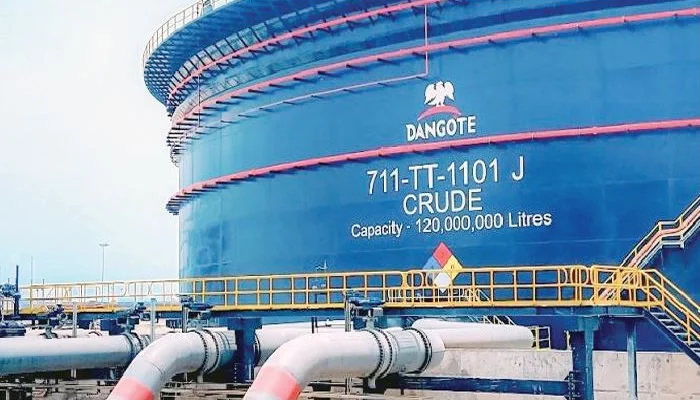

Dangote Industries Limited has expanded its construction equipment fleet by 4,000 machines as work advances on the planned expansion of its Lekki refinery in Lagos.
The latest acquisition takes the company’s total construction equipment to about 6,500 units, including 330 cranes.
The Group Vice President, Oil and Gas and Fertiliser, Devakumar Edwin, disclosed the figures on Friday during a briefing with editors who toured the refinery in Ibeju-Lekki, Lagos.
Edwin said Dangote had initially purchased 2,563 pieces of equipment after some contractors, including Julius Berger, indicated that they did not have the capacity to construct the refinery’s main factory buildings.
“We ended up buying 2,563 pieces of equipment. We became the second largest company in the world in terms of construction equipment. Today, we are the largest because of the expansion,” he said.
“We have bought 4,000 more pieces of equipment; we have 6,500 pieces of construction equipment. We bought 330 cranes,” he added.

Edwin said the decision to purchase the machinery was largely driven by the projected cost of relying on foreign contractors and the need to develop construction capacity within Nigeria.
He explained that foreign contractors would have had to transport their equipment into the country and return it after completing their assignments, while associated depreciation costs could also have been reflected in the project bill.
According to him, Dangote Group President, Aliko Dangote, opted for the company to purchase the necessary equipment rather than incur such additional costs.
Edwin said Julius Berger initially declined to construct the refinery’s main process buildings after reviewing the drawings because the company lacked the required capacity.
The contractor, however, later constructed 43 of the refinery’s roughly 127 auxiliary buildings, including canteens, transformer rooms, control rooms and fire-fighting houses.
The Dangote executive said the company’s decision to build a large construction fleet was also informed by Nigeria’s infrastructure limitations.
He recalled that only two large cranes, each capable of lifting 150 tonnes, were available in Nigeria when Dangote constructed its Apapa sugar refinery in 1998.
For the Lekki refinery project, the company hired one of only two 5,000-tonne cranes in the world, while acquiring 330 cranes of its own.
Edwin said the infrastructure created for the refinery’s initial phase would also support the expansion, helping the company reduce additional expenditure and construction time.
He listed the facilities already developed by the company to include a 10 million-tonne-capacity granite quarry, 82 concrete batching plants, 203 transit mixers, a private port, an oxygen and welding-gas plant and accommodation facilities for up to 50,000 workers.
On the refinery’s current output, Edwin said the facility was producing above its original design capacity of 650,000 barrels per day.
“We have designed the refinery for 650,000, but we are now operating at 700,000. That is over 50,000 barrels per day above the design capacity. So the production volumes are even higher,” he said.
He said Dangote also decided to execute the expansion through its own project company after international contractors quoted fees of about 12.5 per cent of the estimated $19.5bn capital cost.
According to Edwin, the proposed arrangement would have resulted in contractor fees of about $2.5bn.
Rather than proceed with the arrangement, he said, Dangote Projects Limited handled the detailed engineering, procurement and engagement of contractors for the refinery.
“That is how we took up the challenge, and a Nigerian company, Dangote Projects Limited, designed the detailed engineering, went for the tenders, bought every single item, even the nuts and bolts, we bought directly, and engaged contractors, and we constructed the refinery,” Edwin said.
He said the Lekki facility has a single-train capacity that makes it the largest refinery of its type globally, adding that the largest facility before it had a capacity of 430,000 barrels per day.
Edwin said the refinery was designed around both domestic supply and exports, with 44 per cent of its output intended for Nigeria and 56 per cent for export.
He said about 95 per cent of production consists of petrol, diesel and jet fuel, while the remaining five per cent comprises industrial products, including carbon black feedstock.
The refinery was also designed to produce Euro 5 and Euro 6-grade products and process a broad range of African crude grades as well as West Texas Intermediate crude from the United States, he said.
Edwin added that Dangote’s overall refining capacity is projected to reach about 2.1 million barrels per day after the Lekki expansion and the planned 700,000-barrel-per-day refinery project in Kenya.
 We do everything possible to supply quality news and information to all our valuable readers day in, day out and we are committed to keep doing this.
Your kind donation will help our continuous research efforts.
-Advertisement-

-Want to get the news as it breaks?-