
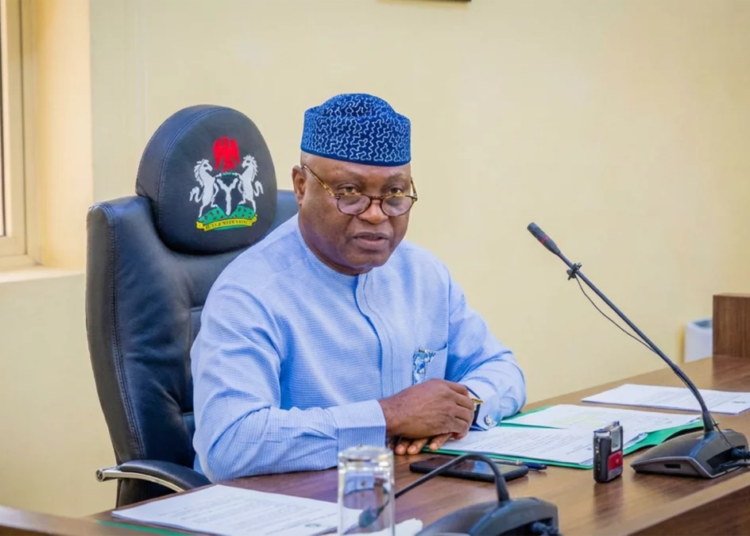
Ekiti State Governor Biodun Oyebanji has said his administration generated a cumulative N88.4 billion in internally generated revenue (IGR) over four years, as the government seeks to strengthen the state’s economy through agriculture, industrialisation and a knowledge-based economy.


Oyebanji disclosed this on Tuesday while delivering his state-of-the-state address at the Ekiti State House of Assembly Complex in Ado-Ekiti to mark the fourth anniversary of his administration and the end of his first term.
The governor said the state had recorded significant growth in revenue generation through administrative reforms, innovative strategies and greater autonomy in revenue collection.

According to him, Ekiti’s monthly IGR averaged between N650 million and N700 million when his administration assumed office in 2022.
The state generated N8.7 billion in 2022, while the figure rose to N12 billion in 2023 and N17.6 billion in 2024. Revenue increased further to N27.1 billion in 2025, while N15.6 billion had been recorded by June 2026.
Oyebanji said the state was averaging N2.6 billion monthly and projected that annual IGR could approach N32 billion by the end of 2026.
He added that independent data from the Joint Revenue Board identified 2025 as an exceptional year for the state’s revenue administration.
### Trade, agriculture drive Ekiti economy
The governor said Ekiti’s economic outlook remained promising, citing figures from the National Bureau of Statistics showing that the state’s gross domestic product rose from N2.4 trillion in 2019 to N4.6 trillion in 2023.
He said recent projections indicated that the state’s GDP was approaching N8.8 trillion.
According to Oyebanji, trade contributed about N1.7 trillion, representing 37 per cent of the economy, while agriculture accounted for N1.05 trillion, or 23 per cent.
The two sectors, he said, contributed approximately 60 per cent of the state’s economic output, prompting his administration to prioritise trade, investment and agricultural development.
He added that investments in aviation and tourism were intended to diversify the state’s economic base.
As the administration prepares for its second term, Oyebanji said the government would focus on linking infrastructure development with productive economic activities to accelerate industrial growth and reduce poverty.
“We will, therefore, be pushing harder in the actualisation of our dreams in the two key economic domains that we want to leverage: agricultural industrialisation and knowledge-based economy through the State Agric Processing Zone and the Ekiti Knowledge Zone,” he said.
### Ekiti secures $80m for knowledge zone
Oyebanji identified the knowledge economy as another priority, saying the state had secured $80 million in funding from the African Development Bank to support its plans for the Ekiti Knowledge Zone.
He informed lawmakers that construction had commenced at the site, describing the project as part of the administration’s strategy to prepare the state for emerging economic opportunities.
The governor said the government would continue to implement its six development pillars, covering governance, youth development and job creation, human capital development, agriculture and rural development, infrastructure and industrialisation, as well as arts, culture and tourism.
### Government highlights pension, education spending
The governor also outlined expenditure on pension obligations and retirees’ welfare.
He said the state government paid more than N36.6 billion in pensions to 10,098 beneficiaries between October 2022 and August 2026, alongside N11.7 billion in gratuities to 3,642 beneficiaries.
He added that an average of N200 million was being set aside monthly to reduce outstanding gratuity liabilities.
For local government retirees, Oyebanji said N35.7 billion had been paid as monthly pensions to about 11,524 beneficiaries, while N7.78 billion had been disbursed as gratuities to 2,659 retirees as of October 2025.
On education, he said the government had paid N8.211 billion to the Universal Basic Education Commission to support a better learning environment in primary schools.
In the health sector, he said the Ulerawa health initiative had provided free services to 932,311 beneficiaries.
The governor also disclosed that about 5,000 young people were engaged in agriculture under different programmes, including the Bring Back Our Youths to Agriculture initiative, which had 4,765 participants in crop production.
Another 126 youths were participating in the Ekiti State Broilers Production Scheme, under which about 200,000 birds had been raised from day-old chicks to table size since the programme began in 2023.
Oyebanji said his administration remained committed to improving economic opportunities and living standards, adding that agricultural processing and the knowledge economy would be central to its next phase of development.
 We do everything possible to supply quality news and information to all our valuable readers day in, day out and we are committed to keep doing this.
Your kind donation will help our continuous research efforts.
-Advertisement-

-Want to get the news as it breaks?-