

The Federal Government has renewed its commitment to making Nigeria open defecation-free by 2030, urging governments, development partners and communities to strengthen efforts towards improving sanitation across the country.


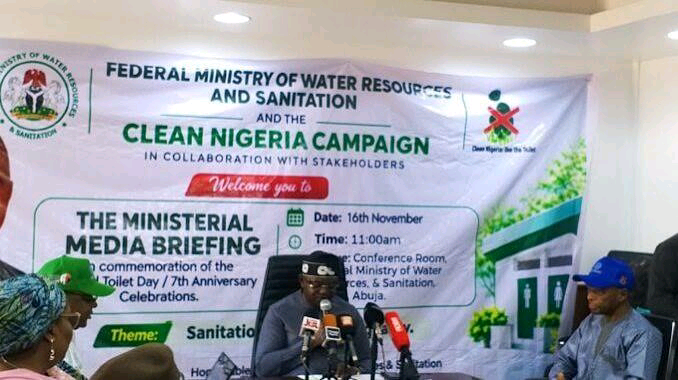
The Minister of Water Resources and Sanitation, Prof. Joseph Utsev, gave the assurance on Monday at a press conference in Abuja to mark World Toilet Day, organised in collaboration with Sightsavers and other partners.
Utsev said the Clean Nigeria campaign, launched in November 2019 with the slogan “Use the Toilet”, had recorded progress, with 185 local government areas attaining open defecation-free (ODF) status. He added that Jigawa and Katsina had achieved statewide ODF status.

He attributed the progress to collaboration among federal, state and local governments, development partners, civil society organisations, the private sector and communities.
However, the minister stressed that ending open defecation required collective responsibility, urging Nigerians to make toilet use a daily habit and discourage the practice in their communities.
He said the government’s objective went beyond increasing the number of ODF local governments to ensuring that every Nigerian had access to safe, affordable and dignified sanitation facilities.
Also speaking, the Director Overseeing the Office of the Permanent Secretary in the ministry, Engr. Ali Dallah, warned that sustaining existing gains remained a major challenge, as communities that had attained ODF status could relapse.
Dallah said achieving the 2030 target would require sustained political commitment, increased investment in sanitation infrastructure, effective monitoring, stronger institutional coordination and continuous behavioural change campaigns.
He disclosed that a national retreat scheduled for November 17 and 18 would bring stakeholders together to review progress, address challenges and develop strategies to accelerate and sustain ODF status.
Dallah also highlighted the 2026 World Toilet Day theme, “Sanitation and Gender Equality”, saying access to safe and quality sanitation facilities was particularly important for women, girls and other vulnerable groups.
He called on the media to intensify public awareness and promote behavioural changes needed to end open defecation nationwide.
 We do everything possible to supply quality news and information to all our valuable readers day in, day out and we are committed to keep doing this.
Your kind donation will help our continuous research efforts.
-Advertisement-

-Want to get the news as it breaks?-