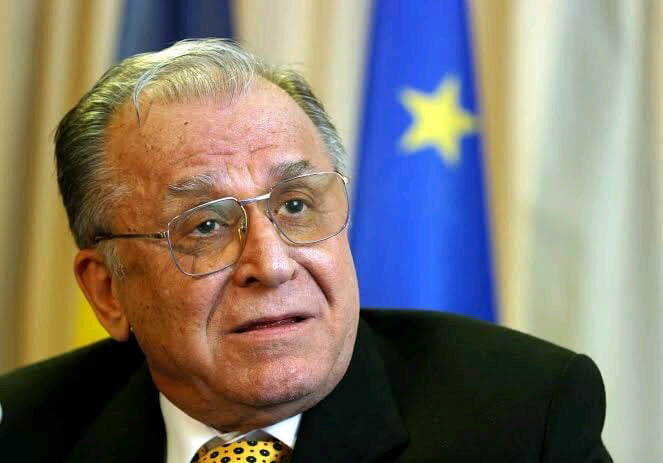

Former Romanian President Ion Iliescu, a central figure in the country’s post-communist political transition, has died at the age of 95. His death was confirmed in a government statement on Tuesday, marking the end of a political era in Eastern Europe.
The late Iliescu, who had been hospitalised since early June for lung cancer, had remained in critical condition before passing away. His last public appearance was in 2017, when he was summoned for questioning by prosecutors over events dating back to the 1989 revolution.


Born on March 3, 1930, Iliescu initially served under communist dictator Nicolae Ceaușescu as youth minister but later fell out of favour. He resurfaced during the December 1989 uprising that ended Ceaușescu’s rule, stepping in as interim leader through the National Salvation Front.

Iliescu won Romania’s first democratic elections in May 1990, securing a landslide victory. He was reelected in 1992, lost in 1996, but returned in 2000 for a final term. His third tenure was marked by Romania’s NATO membership in 2004 and the signing of the European Union accession treaty, which took effect in 2007.
Despite his achievements, Iliescu’s legacy remained controversial. He faced crimes against humanity charges over the violent aftermath of the 1989 revolution, although legal proceedings dragged on for years.
The Romanian government has said funeral details will be announced soon, as tributes pour in from both allies and critics, reflecting the complex legacy of a man who defined modern Romanian politics.
 We do everything possible to supply quality news and information to all our valuable readers day in, day out and we are committed to keep doing this.
Your kind donation will help our continuous research efforts.
-Advertisement-

-Want to get the news as it breaks?-