


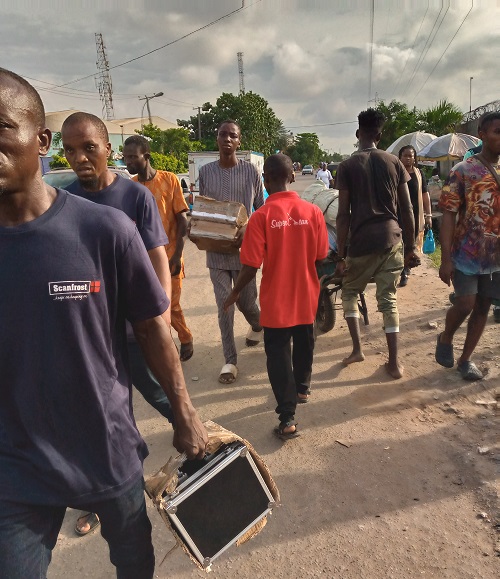

Following the federal government’s removal of fuel subsidy and the astronomical increase by public transport owners, Lagosians have resorted to long-distance trekking as a means of travel, highlighting the challenges faced by ordinary citizens in their daily lives.
President Bola Ahmed Tinubu had on May 29, 2023, at his swearing in announced that subsidy payment on petroleum products had ceased with immediate effect. This has led to abrupt spike in petrol prices from N182 per litre to N500 thus having national rippling effects on the cost of products and services. Even while the administration defended the programme as a means of boosting the economy and raising living standards, current reports of petrol prices exceeding N700 has simply made matters worse for the masses.


As the cost of fuel and public transportation continues to rise, many Nigerians find themselves unable to afford the exorbitant fares. And this has left them with no choice but to embark on long and gruelling journeys on foot, enduring long hours of walking to reach their destinations.
In Lagos, transportation fares to various destinations increased by over 50%, 100% and even 150%. For example, the fare from Oshodi to Ejigbo that was initially N200 is now N500, from Iyana-Ipaja to Oshodi is now N500 as against N300, while from Iyana-Ipaja to Ikeja, went up to N400 from N200.

Similarly, commuting from Berger to Ojuelegba costs N400 instead of N300, while passengers from Berger to CMS had to pay N800 instead of N600. Also, fares from Ketu to Constain rose to N400 from N300, while commuting from Agbara to Mile 2 also rose from N300 to N500.
READ ALSO: JUST IN: Protest rocks Edo over hike in fuel price (Video)
This situation has left many passengers frustrated and stranded, especially as a limited number of buses were available on the road. To economise their fuel, commercial vehicles owners now opt for short trips, hence commuters are forced to trek, while others are seen stranded at various bus stops.
Micheal Omoakin, a teacher, lamented the increase, saying it doubled his daily transportation expenses. “I am spending double the amount I normally spend on transportation. I am appealing to the government to quickly intervene and ensure the availability of fuel to reduce this suffering.”
Uche Ezeani, a trader said he normally paid N600 from Iyana-Ipaja to Idumota but that the fare had increased to N800. “I have two apprentices working at my shop and this means I have to pay N2,400 for all of us to get to the shop. I don’t know how we can continue to do business like this.”
Another respondent is Christian Nnamani, a trader at Ladipo Spare Parts market in Mushin. He lamented that he, alongside his apprentices, now trek every day to their shops. “I have four boys (apprentices) working for me at my shop in Ladipo market. Initially, the fares from my house in Jakande Estate used to be N100. And I used to budget N1000 every day to transport all of us to and fro the market. But now transportation has increased to N200 and N300, it is too much for us to spend about N2000 and N3000 every day, and business has been very dull. So we have adopted trekking to shop every morning to save costs.”
To reduce the cost of transportation many have therefore resorted to trekking long distances in groups or walk a part and pay to cover the remaining distance.
 We do everything possible to supply quality news and information to all our valuable readers day in, day out and we are committed to keep doing this.
Your kind donation will help our continuous research efforts.
-Advertisement-

-Want to get the news as it breaks?-