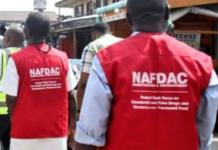






The National Agency for Food and Drug Administration and Control (NAFDAC) has intensified its crackdown on counterfeit products, revealing that goods worth more than ₦1.54tn have been seized or destroyed across Nigeria since 2023.
The Director-General of the agency, Prof. Mojisola Adeyeye, disclosed this on Monday in Lagos, describing counterfeiters as “merchants of death” and warning that NAFDAC would maintain zero tolerance for products capable of endangering consumers.
Adeyeye said one of the agency’s largest coordinated operations took place between February and March 2025, when enforcement teams simultaneously raided major markets in Lagos and the South-East.


The operations at Idumota in Lagos, Onitsha and Ariaria International Market in Aba resulted in the seizure and destruction of more than 137 truckloads of counterfeit and substandard products, valued at over ₦1.5tn.
The agency has also carried out a series of operations targeting fake, expired, banned and unregistered medicines.
In February 2026, NAFDAC destroyed pharmaceutical products worth more than ₦15bn in Ibadan, including Analgin, Co-codamol, codeine-based syrups, Tramadol, Oxytocin and expired vaccines.

It also destroyed about ₦1.8bn worth of counterfeit medicines and other prohibited products in Kuje, Abuja, in March 2026.
Adeyeye said the agency had recorded 64 convictions for counterfeiting, with offenders receiving prison sentences of between one and seven years without the option of a fine.
Among the convictions secured between June 2025 and June 2026 were five-year sentences for the counterfeiting of Global Fund Artemether and a codeine-containing cough and cold syrup, while another offender received seven years for producing fake antibiotics.
The NAFDAC boss said the enforcement campaign had continued beyond raids and seizures, with the agency’s Post-Market Surveillance Directorate visiting 6,233 facilities between May and July 2026.
During the exercise, officials removed 7,210 brands and products from circulation across categories including food and water, medicines, herbal products, medical devices, vaccines, cosmetics and chemicals.
Food and water products accounted for the highest number of items removed, with 3,633 products recovered from 1,808 facilities. The drugs and herbal products category recorded the highest number of facilities visited, with 2,084 facilities yielding 2,459 products.
Adeyeye also disclosed that NAFDAC uncovered the alleged counterfeiting of CWAY dispenser bottles, involving companies accused of refilling empty 19-litre bottles bearing the identity of a registered water company with water from unapproved sources.
The products were reportedly supplied to hotels and supermarkets without authorisation, with the operators subsequently sanctioned by the agency.
She, however, stressed that tackling unsafe products could not be left to NAFDAC alone.
According to her, certain fresh agricultural produce and traditionally packaged staple foods sold in open markets fall outside the agency’s exclusive regulatory control, making cooperation with state and local authorities necessary.
Adeyeye urged Nigerians to report suspected fake or non-compliant products directly to NAFDAC rather than relying solely on social media reports.
She described the fight against counterfeiting as a collective responsibility involving regulators, other government agencies, businesses and consumers.
The agency has also called for tougher penalties for those who manufacture and distribute fake regulated products, including stronger sanctions under relevant Nigerian laws.
 We do everything possible to supply quality news and information to all our valuable readers day in, day out and we are committed to keep doing this.
Your kind donation will help our continuous research efforts.
-Advertisement-

-Want to get the news as it breaks?-