



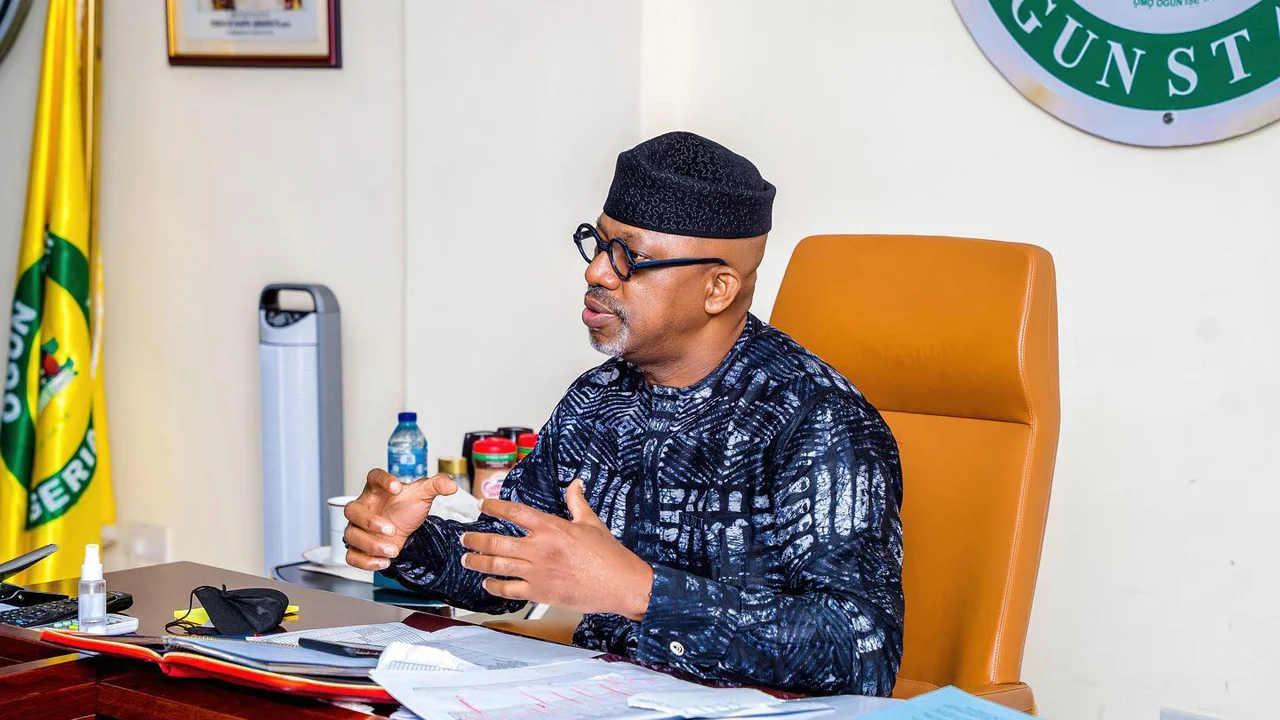

Nigeria would require an additional 554,353 police personnel to adequately staff the proposed state police system, Chairman of the Southern Governors’ Forum and Ogun State Governor, Dapo Abiodun, has said.
Abiodun disclosed this on Thursday while delivering the keynote address at a colloquium held in honour of the late former Ondo State Governor, Oluwarotimi Akeredolu, at the International Conference Centre of the University of Ibadan, Oyo State.
The event, organised to mark Akeredolu’s posthumous 70th birthday, focused on the theme, “Fundamentals and Governance of State Policing: Towards a New Architecture for National Security in Nigeria.”


Abiodun said the state police debate had moved beyond advocacy, arguing that decentralising policing had become necessary to address Nigeria’s security challenges.
According to him, data from the Nigeria Governors’ Forum, based on the United Nations benchmark of one police officer to 414 citizens, showed that the country would need 554,353 additional personnel.
He said the figure translated to about 184,784 recruits annually over a three-year period.

“The debate is no longer whether Nigeria needs State Police, but how swiftly and sustainably we establish it,” Abiodun said.
He argued that the country could no longer sustain a security structure in which policing responsibilities were largely concentrated at the federal level.
“Security is intrinsically local. You cannot police a community whose language you do not speak, whose terrain you do not know. State policing is not a threat to unity; it is the bedrock of stability and prosperity,” he said.
Abiodun seeks funding mechanism
The governor, however, warned that funding disparities among states could undermine the proposed system if adequate safeguards were not put in place.
He noted that Lagos, Rivers, the Federal Capital Territory, Ogun and Enugu accounted for 61.6 per cent of internally generated revenue, while 76 per cent of states generated below the national average of N13,600 per capita.
Abiodun therefore proposed a constitutional State Police Take-Off Fund based on equal-access grants, need-based support and standards-linked disbursements.
He said the funding framework should be strong enough to support salaries, training, equipment, communications, investigations, maintenance and replacement of police assets.
“Insecurity in low-revenue states spills over nationally. Underfunding one state’s police becomes everyone’s crisis,” he said.
The governor added that the Presidential Working Group was developing operational blueprints, financial models, accountability mechanisms and legislative oversight arrangements for the proposed system.
He also called for transparent recruitment and proper vetting of officers, alongside training in investigation, evidence handling, lawful arrest, conflict management, proportionate use of force and protection of vulnerable persons.
Abiodun stressed that political affiliation must not determine access to police protection.
“Political opponents, journalists, peaceful protesters and minority communities deserve equal protection,” he said.
He further called for improved welfare for police personnel, including regular remuneration, proper equipment, medical care, insurance and support for their families.
Aiyedatiwa renews Akeredolu’s state police call
Ondo State Governor Lucky Aiyedatiwa said Akeredolu’s advocacy for state police had moved from a regional campaign to the centre of Nigeria’s national policy and constitutional debate.
Aiyedatiwa, who served as Akeredolu’s deputy before succeeding him as governor, recalled the late governor’s role in the establishment of the Western Nigeria Security Network, popularly known as Amotekun, in January 2020.
He said the security outfit demonstrated the importance of giving communities a meaningful role in protecting themselves.
“What Akeredolu and other progressive voices once advanced as a necessary response to the realities of our federal structure has now entered the very centre of Nigeria’s national policy and constitutional conversation,” Aiyedatiwa said.
He said the challenge was now to establish a state police system that would be responsive, professional and accountable while protecting citizens from abuse.
“The Nigerian federation must find the balance between national cohesion and local responsiveness; between federal authority and subnational capacity; between operational effectiveness and fundamental rights,” he said.
Former Ekiti State Governor Kayode Fayemi also paid tribute to Akeredolu, describing him as a leader whose advocacy for a decentralised security system outlived his tenure.
Fayemi said Akeredolu’s contribution went beyond the establishment of a regional security outfit, arguing that his legacy included demonstrating how regional cooperation could produce practical responses to security challenges.
The Director-General of the Development Agenda for Western Nigeria Commission, Seye Oyeleye, said the conversation should now shift from whether Nigeria needed state police to how it could be effectively implemented.
“How do we fund it? How do we train and equip it? How do we guard against abuse? How do we keep it accountable to the people, not to politicians?” Oyeleye asked.
He said state policing should not be viewed as a regional or ethnic project but as a national response to Nigeria’s federal structure and security challenges.
 We do everything possible to supply quality news and information to all our valuable readers day in, day out and we are committed to keep doing this.
Your kind donation will help our continuous research efforts.
-Advertisement-

-Want to get the news as it breaks?-