
The battle for Osun State is no longer simply a contest between political parties. With the governorship election only days away, the major contenders are attempting to convince voters that their individual records, programmes and governing philosophies offer the best route out of the state’s problems.
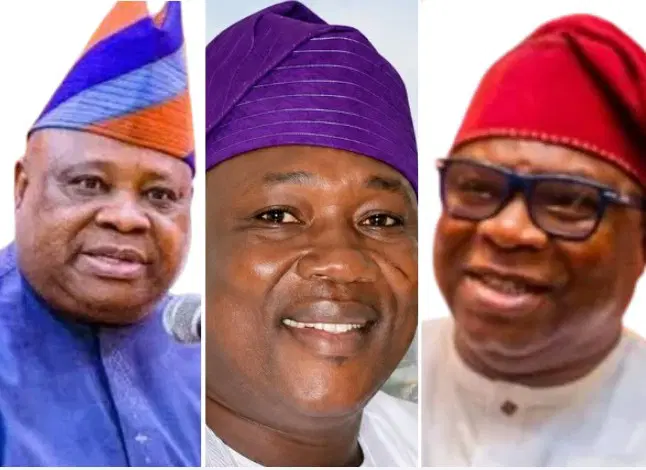
At an Arise Town Hall Meeting in Osogbo, the four frontline candidates — Governor Ademola Adeleke of the Accord Party, All Progressives Congress candidate Asiwaju Munirudeen Bola Oyebamiji, African Democratic Congress candidate Dr Najeem Salaam and African Action Congress candidate Olajide Esan — presented remarkably different arguments for why voters should entrust them with the state’s affairs.
Adeleke approached the debate as an incumbent defending a record he believes is visible across the state.


Oyebamiji framed the election as an opportunity for Osun to change direction, particularly on poverty, agriculture, education, healthcare and security.
Salaam placed peace and political stability at the centre of his campaign, while Esan argued that the deeper problem is the failure of successive political leaders to put citizens at the centre of governance.
Together, their positions reveal four competing ideas about what Osun needs after August 15.

Adeleke’s Bet: Let The Projects Speak
For Adeleke, the strongest argument for another term is his administration’s record.
The governor repeatedly returned to infrastructure, healthcare, agriculture and security as evidence that his government has moved beyond campaign promises.
He said about 350 kilometres of roads had been constructed under his administration, with another 160 kilometres still being worked on. He also claimed that several roads abandoned for years had been completed.
“I promised my people of Osun State that I would govern with the fear of God and bring home what is called the dividends of democracy. Our work speaks for itself.”
The governor believes the physical changes are now difficult to ignore.
“A lot of people have come down to Osun State, especially the state capital, and they missed their way because of the transformation we have accomplished.”
Healthcare was another major part of his defence.
Adeleke said his administration had rehabilitated about 200 health centres and provided them with equipment and basic infrastructure, including beds and solar lighting.
“When I came in, I went around all our health centres. I said this is not acceptable. As of today, we have fixed about 200 healthcare centres. We put poles, solar lights, beds and everything is looking so beautiful,” he said.
In agriculture, he said the government had purchased 31 tractors and distributed seedlings and other inputs to farmers.
But the governor’s defence was not limited to development projects. He also sought to project himself as a politician who could withstand pressure from Abuja.
‘Bring All The Governors’
The support of APC governors and the Federal Government for Oyebamiji has become one of the major talking points of the election.
Adeleke said he was not intimidated.
“I am a bulldozer. I am talk and do. I am not afraid of federal might and governors backing the APC candidate. If they like, they should bring all the governors,” Adeleke said.
He argued that the governors’ presence would not automatically translate into votes.
“Those governors are my friends. I am a civilised administrator. They won’t vote; they can only come and dance, and after the election, we will meet,” he said.
The governor also rejected accusations that his administration had militarised the state ahead of the election.
“I did not militarise Osun. I have no such capacity. I am not the Commander-in-Chief of the Armed Forces. Mr President is the Commander-in-Chief,” he said.
On Amotekun, Adeleke said more than 1,500 personnel had been recruited and trained by retired military and police officers before being deployed across the state.
His position on state police was equally emphatic.
“I believe in state police. When I was in the Senate, I was the one that introduced State Policing. If it is my son that committed an offence, he will go and face the law.”
“I am not going to bend for anybody. I believe in the rule of law,” he added.
The Vote Must Be Protected
As the election approaches, Adeleke has also been urging voters to remain at polling units after voting and monitor the counting process.
“I am always preaching free and fair elections because I know what is called democracy. It is the people. It is the Osun people that will decide.”
He added:
“My people, this election is going to be a free and fair election. No violence. When you vote, stay and make sure your vote is counted. Follow your vote from the unit to the collation centre.”
But the governor was less diplomatic when asked whether he would congratulate his opponent if he lost.
“Forget about it. I’m not going to lose this election because I’m so confident.”
Oyebamiji’s Argument: Osun Needs A New Direction
Oyebamiji is approaching the election from the opposition bench, and his campaign is built around the argument that the state’s resources have not translated into sufficient improvement in the lives of ordinary residents.
His message is deliberately centred on the people rather than particular communities.
“Governance is about people, it’s not about segments. It’s not about an area. It’s not about a city. It is not about a town. It’s the entirety of the state,” he said.
His economic agenda focuses heavily on hunger and poverty.
“We want to banish hunger and poverty. I want to invest seriously in agriculture, education, and health,” he said.
Security and human capital development, he added, would also receive attention under his administration.
Oyebamiji dismissed the suggestion that his campaign was dependent on alleged plans by the Federal Government to use its influence to secure victory.
He said his campaign across the state had not produced evidence of such a plan.
“I actually listened to Mr. Governor and I can see that most of the answers to that question were not true. I have visited 30 local government areas in Osun State three times. Nobody has ever heard that,” he said.
His conclusion from those visits, he said, was that many residents wanted a new government.
“I am convinced beyond reasonable doubt that our people in Osun are ready for a change. I’m coming here as the incoming governor of Osun, come August 15, 2026,” he said.
The Fight Over Osun’s Money
The financial management of Osun became another major dividing line between the two leading candidates.
Oyebamiji questioned what he described as a gap between the resources available to the Adeleke administration and the level of development visible across the state.
He claimed Osun received approximately N650 billion in federal allocations during Adeleke’s three-and-a-half years in office.
By comparison, he said the state received about N450 billion during the 12 years of APC rule under former governors Rauf Aregbesola and Gboyega Oyetola.
Oyebamiji further maintained that Oyetola left about N15 billion for the incoming administration.
He questioned how the N650 billion received under Adeleke translated into development.
“How does N650 billion match what we see in Osun today?”
He also alleged that 97 per cent of the resources went to only two local government areas, describing such concentration as unacceptable.
“That is an aberration; actually, it is criminal,” he queried.
The claims are central to the APC’s argument that the election should be a judgment on the incumbent administration’s stewardship of public funds.
Salaam’s Campaign: Peace Before Projects
Salaam is offering voters a different proposition.
Rather than making infrastructure the centre of his campaign, the ADC candidate has placed political stability, good governance and an end to thuggery at the heart of his message.
He said his experience in governance, academic training and background as a farmer had prepared him for the responsibility of leading the state.
“I’m contesting to build on achievements of past governments that did it well and to correct the challenges that we have today,” Salaam said.
He promised a government that would be accountable and focused on citizens.
“My government is going to be a people-centred government,” he said.
Salaam also used his academic background to distinguish himself from his opponents.
“My doctorate degree is not honorary. It’s a doctor of philosophy in political science. I read political science in my first degree, second degree, and up to the PhD level,” he said.
But it was his warning about political violence that produced perhaps his strongest message.
“Osun people do not want thuggery again because they see us as the most peaceful party. They also know the only candidate that can bring peace is Najeem Salaam and the only party that can bring peace is the ADC,” he said.
Salaam alleged that the state was already experiencing a dangerous proliferation of political weapons and warned that the wrong electoral choice could deepen the problem.
“Osun people know that if they give it to A or B, they will fight. I can tell you that Osun is filled with thuggery and ammunition. So, we will bring peace,” he said.
His promise is ultimately a combination of peace, accountable leadership and development.
“To build a better today and tomorrow for Osun. I will go in to develop Osun in a better way, give people what belongs to them. I am more fit than any other governor,” he said.
Esan’s Alternative: Put Citizens In Control
For Esan, the problem is more fundamental.
The AAC candidate believes Osun needs to change the relationship between government and citizens.
He accused politicians of turning poverty and hardship into political capital rather than addressing the problems themselves.
His central pledge is therefore to return governance to the people.
“Going into my vision, what is important to me is to give governance back to the people, because instead of leaders serving the people in Nigeria, especially in Osun State, it is the people who are serving the leaders,” he said.
One of his key proposals is an Osun Residents Database.
The idea, he explained, is to provide government with reliable information about residents so that policies and public services can be better targeted.
“Part of the plans, we have what I call the Osun residents database. This database will give us the opportunity to have the information of Osun residents and to also be able to put the right things in place for Osun people,” he said.
His second major proposal is a financial dashboard through which citizens would be able to monitor government spending.
“Financial dashboard will give Osun people the opportunity to monitor and to track government spendings, so that if one error happens, they can call me, ‘youth governor, where is our one naira?’” Esan said.
He believes transparency is also the key to reducing the attraction of politics as a personal business.
“Accountability is very important. Because the lack of accountability is what is making politics a lucrative business to career politicians,” he said.
The Real Contest: Four Different Answers To Osun’s Problems
The significance of the Osun election lies partly in the fact that the leading candidates are not offering identical solutions.
Adeleke is asking voters to look at roads, health centres, agriculture and other projects and decide whether his administration deserves another term.
Oyebamiji is asking the electorate to examine the state’s economic condition and the management of its resources before choosing continuity.
Salaam is presenting peace and the elimination of political thuggery as the foundation upon which meaningful development must be built.
Esan is proposing a more radical shift in the mechanics of governance, with citizens given greater access to information and tools for monitoring public expenditure.
The election will therefore test more than party strength.
It will test whether voters prioritise continuity or change; physical projects or economic reform; security and political stability or a new model of citizen participation.
For the candidates, the town hall was another opportunity to define themselves.
For the electorate, it was an opportunity to compare the promises.
But ultimately, the final verdict will not come from the debate stage, campaign podium or party headquarters.
It will come from the ballot boxes across Osun State on August 15.
 We do everything possible to supply quality news and information to all our valuable readers day in, day out and we are committed to keep doing this.
Your kind donation will help our continuous research efforts.
-Advertisement-

-Want to get the news as it breaks?-