





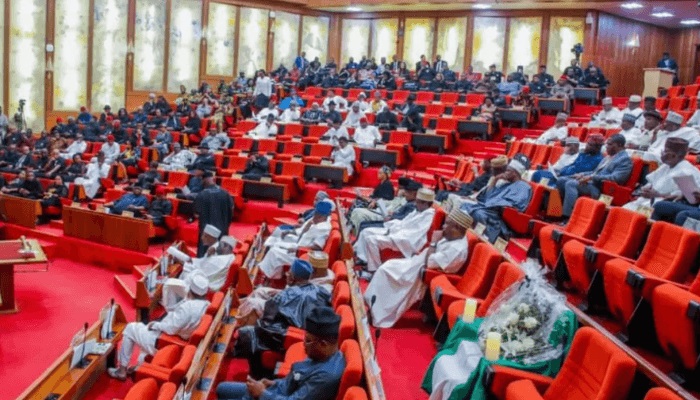

The Senate has assured Nigerians that the proposed State Police Bill will not be delayed by the National Assembly’s annual recess, with lawmakers expressing confidence that the harmonisation process will be completed before plenary resumes in September.
Chairman of the Senate Committee on Media and Publicity, Senator Yemi Adaramodu, said legislative committees would remain fully operational throughout the recess to fast-track work on the constitutional amendment widely regarded as a major security reform.
Speaking in an interview, Adaramodu explained that although plenary had been suspended until September 14, committee activities would continue to ensure the bill progresses without interruption.


“Our holiday does not stop harmonisation since we have committees. The National Assembly will resume on September 14, but the recess doesn’t stop the committees of the two chambers from meeting,” he said.
He noted that lawmakers traditionally use the recess period to carry out committee assignments and oversight functions, stressing that urgent legislative matters would continue to receive attention.
“If we have emergency committee matters to handle, we still do that. But we don’t go to plenary,” he added.

According to the Senate spokesman, the Constitution Review Committee, chaired by Deputy Senate President Barau Jibrin, is responsible for harmonising the bill with the version passed by the House of Representatives.
Adaramodu said the Senate deliberately separated the State Police Bill from other constitutional amendment proposals to prevent delays and ensure speedy consideration.
“The state police matter is not even the only one that we are dealing with. But this one is an emergency because it is a popular demand by Nigerians.
“It has already become more of a national debate and discourse, so we cannot just sit and not attend to it expeditiously,” he said.
He explained that considering several constitutional amendment bills simultaneously could prolong legislative debates, public hearings and consultations, delaying reforms.
“So we don’t want to make the state police matter a porous debate. That’s why we singled it out to deal with it expeditiously before transmitting it to the executive for assent,” he added.
The lawmaker also disclosed that the National Assembly had secured the cooperation of state legislatures, whose approval is required before the constitutional amendment can take effect.
According to him, consultations had already been held with the Speakers of the 36 state Houses of Assembly, while governors had also expressed support for the proposed legislation.
“The feedback we got from them is positive. Again, the Nigerian Governors’ Forum had already sat earlier on the matter. Recently, the governors themselves signalled that they are very much interested in this bill,” Adaramodu said.
He expressed optimism that the harmonisation process, transmission to state assemblies and other legislative procedures could be concluded within the next two months.
“I don’t think this can take more than maybe two months. I think by September, we should have been able to get all these things done,” he said.
The Senate’s assurance came a day after the Presidency announced that President Bola Tinubu is expected to receive the draft Executive National Policing Bill on September 3 as part of broader efforts to reform Nigeria’s policing system.
Chief of Staff to the President and Chairman of the Presidential Working Group on the National Policing Bill, Femi Gbajabiamila, said the executive proposal forms part of a seven-week implementation programme running from July 27 to September 14.
He also unveiled a public information portal to enable Nigerians submit memoranda and position papers before the draft legislation is transmitted to the National Assembly.
Gbajabiamila clarified that the Executive National Policing Bill is separate from the constitutional amendment on state police already passed by both chambers of the National Assembly.
According to him, while the constitutional amendment provides the legal foundation for establishing state police, the executive bill will set out the operational framework for implementing the new policing architecture if approved.
 We do everything possible to supply quality news and information to all our valuable readers day in, day out and we are committed to keep doing this.
Your kind donation will help our continuous research efforts.
-Advertisement-

-Want to get the news as it breaks?-