



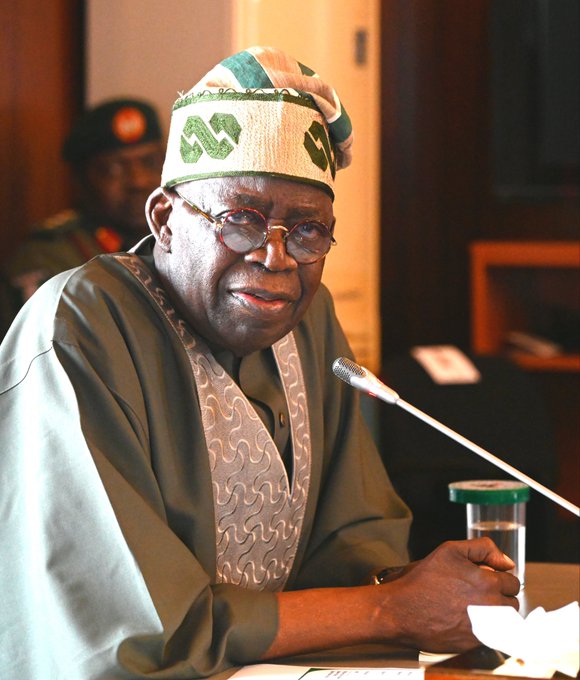

President Bola Tinubu has called for a major reform of the United Nations Security Council, demanding at least two permanent seats for Africa with full membership rights, including veto powers for as long as the veto remains.
Tinubu made the demand on Thursday while addressing the General Debate of the 81st session of the United Nations General Assembly in New York. The address was delivered on his behalf by Vice President Kashim Shettima.


The President also called for five non-permanent seats for Africa, arguing that the continent should have a stronger voice in decisions affecting international peace and security.
He said the reform of the UN must begin with changes to the Security Council, insisting that Africa could no longer remain largely excluded from permanent membership while continuing to contribute to global peace and security.
“The reform of this institution must begin with the reconstitution of the Security Council, for the world of 2026 cannot remain captive to the distribution of power in 1945. Africa cannot continue to fill the Council’s agenda while remaining absent from its permanent membership.”

Tinubu said Nigeria’s position was consistent with the Ezulwini Consensus and Sirte Declaration, which form the basis of the African Union’s common position on Security Council reform.
Under the African position, the continent is seeking no fewer than two permanent seats and five non-permanent seats, with the same rights and privileges as other permanent members, including veto power if the veto remains part of the Council’s structure.
The Security Council currently has 15 members, comprising five permanent members — China, France, Russia, the United Kingdom and the United States — and 10 non-permanent members elected for two-year terms.
Tinubu also used his address to outline Nigeria’s position on global security, climate change, artificial intelligence, development financing and international trade.
On security, he said Nigeria’s experience in confronting Boko Haram, ISWAP and other armed groups showed that military action alone could not guarantee lasting peace.
He said sustainable peace required investment in education, economic opportunity, accountable governance and the protection of citizens’ rights.
The President also urged the international community to strengthen cooperation against terrorism, organised crime, cyberattacks and illicit financial flows.
On climate change, Tinubu rejected what he described as a false choice between economic development and climate action.
He said developing countries should be supported to industrialise, eradicate poverty and expand energy access while pursuing lower-carbon development pathways.
“Africa contributes less than four per cent of greenhouse gas emissions, yet bears disproportionate consequences,” he said, while reaffirming Nigeria’s commitment to the Paris Agreement and an equitable energy transition.
Tinubu said Nigeria’s Energy Transition Plan targets net-zero emissions by 2060 while expanding access to affordable and reliable energy.
He also called for climate finance arrangements that would provide developing countries with predictable and accessible funding without undermining their development goals.
On artificial intelligence, the President called for responsible use of the technology, saying its impact would depend largely on how it was deployed.
“We can deploy artificial intelligence to wage war or use it to transform healthcare, education, agriculture, governance and economic productivity,” he said.
Tinubu said Nigeria was investing in digital public infrastructure, broadband connectivity, research, innovation and technology entrepreneurship, while inviting international partners to work with Nigerian youths in directing AI towards development.
The President further called for reforms to the global financial system, greater access to concessional financing and debt sustainability frameworks that take developing countries’ needs into account.
He also highlighted the African Continental Free Trade Area as an opportunity to expand intra-African trade, strengthen regional value chains and promote industrialisation.
Tinubu urged African countries to move beyond exporting raw materials by increasing value addition, manufacturing, technological innovation and knowledge-based production.
“Our abundant natural resources must become engines of shared prosperity rather than sources of perpetual dependency,” he said.
The Nigerian President’s demand comes amid continuing negotiations over reform of the Security Council and broader calls for greater representation of Africa in global decision-making institutions.
The African Union’s reform model provides for an enlarged council with at least two permanent seats for Africa and five non-permanent seats. UN documents show that member states remain divided over whether any new permanent members should receive veto powers.
UN Secretary-General António Guterres has also publicly backed reform, saying in February that Africa’s absence from the permanent membership of the Security Council was “indefensible” and that global institutions needed to reflect contemporary realities.
Tinubu concluded by reaffirming Nigeria’s support for multilateral cooperation, dialogue and a reformed United Nations capable of addressing contemporary global challenges.
 We do everything possible to supply quality news and information to all our valuable readers day in, day out and we are committed to keep doing this.
Your kind donation will help our continuous research efforts.
-Advertisement-

-Want to get the news as it breaks?-