
In the late autumn of the late 1970s, the University of Ife—now Obafemi Awolowo University—was not just an institution of higher learning; it was a crucible of intellectual radicalism and artistic fervour. To be an undergraduate there between 1979 and 1982 was to exist in the shadow of giants. Chief among them, carrying an almost mythological aura, was Professor Wole Soyinka.
For my close friends—Akin Osho and Godwin Erapi—and me, our daily pilgrimage after lectures did not lead to the libraries but to the strategic market near the Theatre Arts Department. We went in search of palm wine, that sweet, fermenting nectar that seemed to lubricate the intellectual wheels of the campus.
Almost always, at the outer court of the department, Wole Soyinka would be standing. He was already a global literary force, years before the Swedish Academy would make him Africa’s first Nobel Laureate in Literature. Yet, there he was, holding a glass of wine, framed by his iconic crown of snow-white hair, looking less like an untouchable academic deity and more like a permanent fixture of the campus landscape.


We watched him from a distance, awed, keeping our respectful, youthful space. To us, he was the storm—the man who had held up a radio station in the old Western Region, the political dissident, the master of prose. We did not dare approach. He was a monument.
It would take nearly four decades for that monument to step off his pedestal and show me his true, disarming humanity.
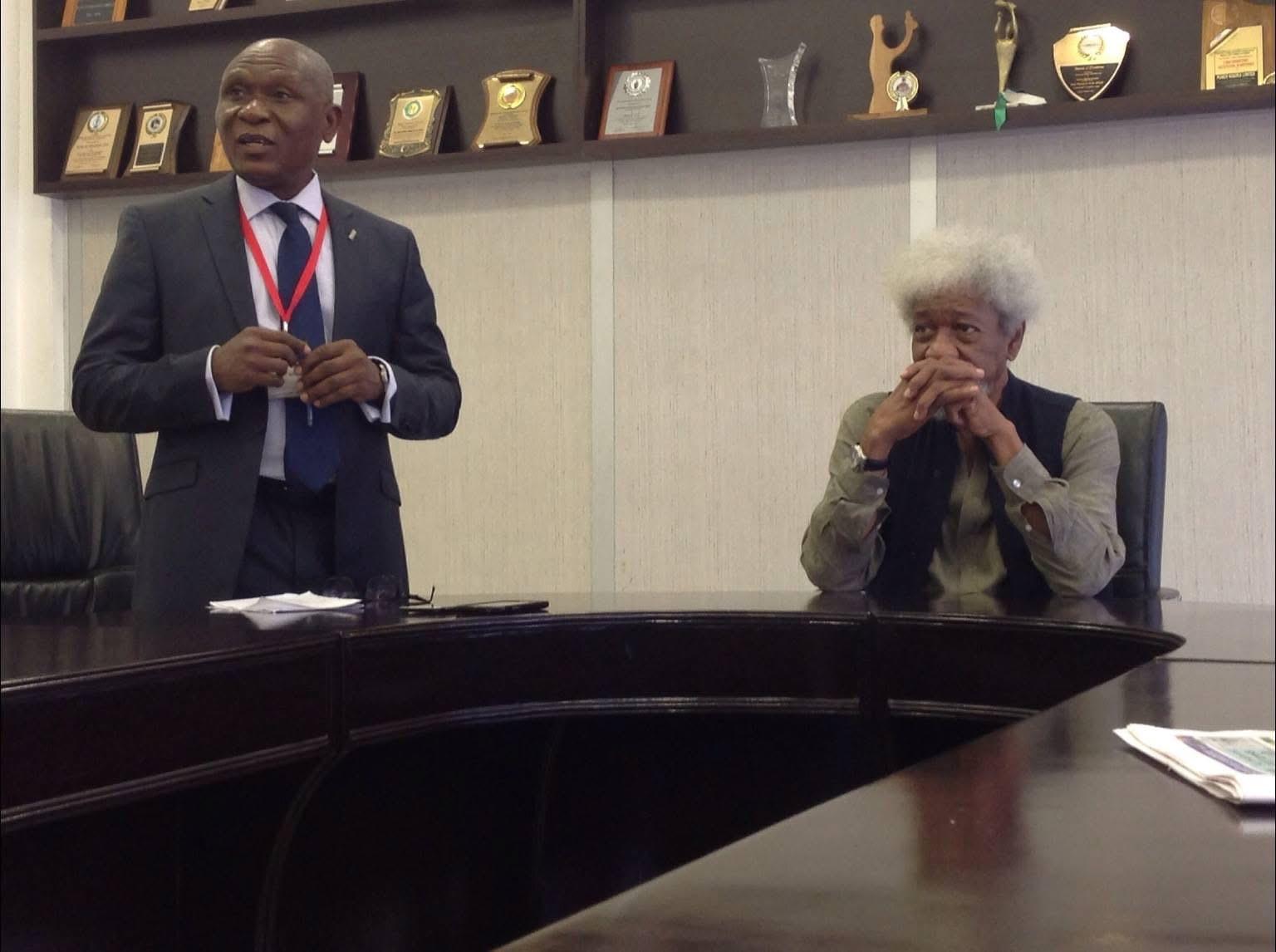
Our paths crossed intimately in 2020. I was serving as the Chairman of the Editorial Board at The PUNCH. We had established “The PUNCH Forum”—a high-minded, intellectual salon designed to bring the country’s brightest minds into a no-holds-barred dialogue with our senior editorial staff.

When it was Soyinka’s turn to grace the forum, the newsroom was tight with anticipation. We expected the grand entry typical of Nigerian public figures: a blaring convoy of vehicles, security details pushing people aside, and an entourage of sycophants carrying briefcases.
Instead, a dusty, barely recognizable SUV pulled into the gravel driveway of The PUNCH headquarters.
There were no sirens. Out stepped Wole Soyinka, accompanied only by his driver and a young boy whom he introduced to me with profound, almost paternal affection. At 86 then, he possessed the quiet grace of a traveler who had long discarded the heavy luggage of self-importance.
Because he arrived ahead of schedule, the responsibility of hosting him in the quiet of the waiting room fell upon me. Hanging on the wall of that room was a large portrait of the writer himself. Soyinka stopped, looked at the image, and a soft smile creased his face. He instantly recalled the exact moment, decades prior, when that photograph had been captured.
Then, with a mischievous twinkle in his eye, he asked: “Where is Miss Samuel?”
Miss Samuel was our Editorial Board Research Officer, the young lady who had spent weeks doggedly coordinating his schedule, sending emails, and managing the logistics of his visit. When I brought her into the room, Soyinka laughed warmly.
“So, this is the lady that has been bombarding me with phone calls!” he quipped.
In that single, humorous observation, the tension in the room evaporated. The titan had dissolved the corporate barrier, acknowledging a young professional not as an administrative afterthought, but as the true director of his arrival.
As we waited for the forum to commence, our conversation drifted back to his days at Ife. I reminded him of the campus lore that we, as students, had whispered to one another. Specifically, I recalled the legendary moment he was awarded his professorship. Rather than basking in the grandiosity of the title, Soyinka had famously posted a brief, defiant disclaimer across the campus: He remained Wole Soyinka.
He laughed, appreciating the memory of a younger, rebellious self.
By the time we walked into the Conference Room for the forum, the nervous anxiety that usually precedes hosting a Nobel Laureate had completely vanished. Soyinka had gifted me a quiet, inexplicable confidence. When I stood up to deliver the introductory remarks, the words flowed with a rare, effortless warmth—a performance that many of my colleagues later described as one of my best outings.
During the session, Soyinka did what he does best: he laid bare the complex, often tragic realities of the Nigerian state. He did not speak in the detached, esoteric language of the academy. He spoke with the urgency of a citizen whose heart still bleeds for his country. His insights that afternoon became the bedrock of our editorial perspectives for months to follow.
Yet, what lingered with me far longer than his political analysis was his profound humility.
Throughout my career in journalism, I have met the spectrum of Nigeria’s elite. I have sat with presidents, billionaires, and self-appointed gatekeepers of society. I have witnessed the toxic arrogance of mediocre men who demand worship, and the quiet insecurity of leaders who use power to intimidate.
Soyinka was different. He was a supreme leveler of social strata. In his presence, there was nothing to fear, nothing to fret about, and absolutely nothing designed to make you feel small.
As Wole Soyinka reaches the remarkable milestone of 92, Nigeria finds itself in a deep, introspective moment. We live in a society increasingly obsessed with titles, hero-wirshipping, wealth, and the superficial trappings of authority. Our public square is dominated by loud, defensive voices that demand respect without earning it.
In this climate, Soyinka’s life remains a vital counter-narrative.
His greatness does not lie in the Nobel gold medal kept in some vault, nor does it lie in the library of books that bear his name. His true greatness is found in his accessibility—the ease with which he transitions from the high tables of global diplomacy to a casual joke with a young research officer in a Lagos newsroom.
The Soyinka I met is a man who conquered the world but chose to remain grounded in the soil of his homeland. He reminds us that true intellectual giants do not tower over us to make us feel insignificant; they stand beside us, holding a glass of palm wine, inviting us to look at the world with the same fierce, uncompromising clarity.
At 92, he is more than a national treasure; he is a reminder of what we can be when we refuse to let our achievements distance us from our shared, fragile humanity.
Happy nonagenarian birthday, our Nobel Laureate.
Adediran, a former PUNCH Editorial Board Chairman, wrote via olusegunadediran@gmail.com
 We do everything possible to supply quality news and information to all our valuable readers day in, day out and we are committed to keep doing this.
Your kind donation will help our continuous research efforts.
-Advertisement-

-Want to get the news as it breaks?-